


6 Billion Simulations Per Weekend: How Top Teams Use 'Shadow R&D' to Outrun the FIA’s Budget Auditors

In the golden age of Grand Prix racing, victory belonged to the team with the newest wind tunnel and the deepest pockets. Today, that world is dead. With the FIA’s cost cap squeezed to a lean $215 million, the quest for aerodynamic supremacy has migrated from the carbon fiber shop to the server room—an invisible battlefield governed by a "Compute Cap" more ruthless than any budget auditor. When Red Bull breached the limit by a marginal $2.6 million, they didn't just pay a $7 million fine; they were stripped of 10% of their digital development time, a deficit that translates to a brutal 0.2 seconds per lap. This is the new science of "Digital Cents," where investing $10 million in a state-of-the-art server cluster is a high-stakes gamble that could either unlock the next world championship or bankrupt your manufacturing budget before the first race even begins.
The concept of the Compute Cap represents a fundamental paradigm shift in motorsport financial engineering. Historically, the pursuit of aerodynamic efficiency was limited only by a team's financial resources. Elite constructors operated multiple physical wind tunnels 24 hours a day and deployed sprawling, unrestricted supercomputers to run Computational Fluid Dynamics (CFD) simulations. Today, the regulations impose a strict, mathematical limit on the volume of CFD calculations and wind tunnel testing a team can execute. Under a strict cost cap, every dollar spent on server infrastructure is a dollar taken away from manufacturing physical parts.
The thesis governing the modern era of Formula 1 is uncompromising: the team that manages its "Digital Cents" most efficiently is the one that will ultimately claim the championship. Every digital simulation has a hard regulatory cost, forcing engineers and financial directors alike to treat server hours as a finite, rapidly depleting resource.
Decoding the "MAUh": The Financial Formula for Digital Speed
To effectively regulate computational fluid dynamics, the FIA established the Allocation Unit hour (AUh), which is strictly defined as being equivalent to a single core hour on a physical Central Processing Unit (CPU) core. This is officially measured in Mega Allocation Unit hours (MAUh). Think of it as a strict digital budget. This budget is based on a rigid formula that dictates how fast a team's aerodynamic software can run.
To understand how teams try to secretly get ahead on this computer diet, you need to know the three main parts of the formula (NCU X NSS X CCF):
NCU (Number of Compute Units): This is simply the exact number of physical computer cores (the brains of the server) used. The FIA is very strict: they count the real, physical chips, ignoring any tricks to make one core look like two.
NSS (Number of Solver Seconds): This is the total time, in seconds, the main calculation takes to finish. Teams want this number to be as small as possible.
CCF (Core Clock Frequency): This is how fast the computer's processor is running, measured in gigahertz. Teams can't slow down the processor to save time on their budget—that's against the rules.
To enforce this, the FIA demands complete digital transparency. Every team must declare one specific, dedicated computer cluster solely for these highly restricted calculations, which the governing body then digitally "seals" and monitors.
Because the formula strictly multiplies the core count (NCU) by the clock speed (CCF), teams quickly realized they couldn't cheat the system by just buying the fastest processors or using a giant number of chips. Doing so would instantly use up their entire computer budget. Instead, the core financial strategy became: Minimize the Number of Solver Seconds (NSS).
The special software used for airflow analysis (CFD) needs massive amounts of memory bandwidth. To solve the problem of slow memory without increasing their core counts (and thus their budget), F1 teams started pouring money into specialized hardware. The most successful innovation is using processors with 3D V-Cache technology. This innovation essentially triples the processor's immediate, super-fast memory (called the L3 cache). By keeping huge amounts of the complex airflow data right next to the processor, teams drastically cut down on the time-wasting trips to the main, slower system memory.
This hardware investment is a massive competitive advantage. For a team like Mercedes, switching to these powerful processors instantly led to a 20% efficiency improvement. In the zero-sum game of this computer budget, a 20% faster calculation means the team can run 20% more aerodynamic tests within the exact same limit set by the FIA. They are effectively buying "free" development time through smart silicon purchasing.
The "Thinking Partner" Arms Race: Shifting CapEx to OpEx
Constrained simultaneously by the fixed MAUh limits and the hard $215 million financial cost cap, maintaining massive, on-premises supercomputers—which require constant hardware depreciation, enormous power consumption, and vast capital expenditure—is a massive liability. To navigate these dual constraints, teams have outsourced their computational heavy lifting to global cloud providers, transforming rigid infrastructure costs (CapEx) into highly flexible operational expenses (OpEx).
Oracle Red Bull Racing: The Elastic Strategy Budget
Oracle Red Bull Racing’s dominance is heavily underpinned by their utilization of Oracle Cloud Infrastructure (OCI). While aerodynamic CFD is capped by the MAUh formula, race strategy simulation is not. Modeling the chaotic realities of a Grand Prix requires massive processing power, which directly impacts the financial cost cap.
Red Bull leverages OCI to run up to 6 billion individual Monte Carlo simulations prior to and during a single race weekend to model every conceivable strategic permutation (Oracle Red Bull). By fully containerizing their software via Kubernetes, Red Bull instantly spins up thousands of Arm-based virtual servers, achieving a staggering processing velocity of 1 million Monte Carlo simulations per second (Oracle Red Bull).
Crucially, the pay-as-you-go commercial model of cloud computing ensures that Red Bull only incurs financial cost cap hits for the exact compute hours utilized. When the race ends, the servers are spun down, immediately terminating the financial burn rate and avoiding the massive overhead of permanent infrastructure.
Mercedes & SAP: Automating Financial Compliance
For the Mercedes-AMG Petronas F1 Team, the impending transition to the 2026 regulations brings a heavily revised financial framework, with the cost cap set to expand to $215 million to envelop previously exempted expense categories. As teams rely increasingly on elastic cloud computing and rapid manufacturing, the risk of inadvertently breaching the cost cap through opaque operational spending is an existential threat.
Mercedes partnered with SAP to deploy the S/4HANA Cloud ERP Private edition to serve as a ruthless, enterprise-wide tracking mechanism. Every physical asset and digital expenditure is meticulously accounted for in real-time, tracking the complete lifecycle and exact valuation of over 14,500 individual car components (Datacentre Solutions) By utilizing SAP Business AI, Mercedes can generate highly accurate predictive budgets, ensuring that a sudden spike in cloud server compute hours or emergency manufacturing costs does not inadvertently push the team over the regulatory financial cliff.
The Cadillac/Andretti Cap Exemption
A massive structural loophole exists for entities aspiring to join the grid. Existing F1 teams are strictly bound by the ATR and the financial cost cap. However, a prospective entrant is not subject to FIA digital audits, MAUh quotas, or financial reporting until their formal entry is ratified.
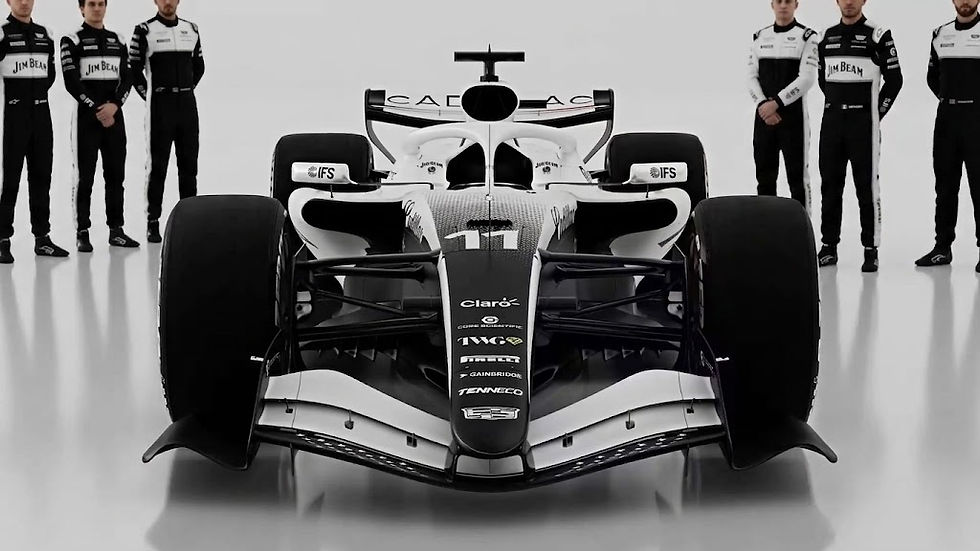
The General Motors/Cadillac bid actively leveraged this dynamic to secure a massive financial and developmental advantage. Operating entirely outside the purview of the FIA’s digital panopticon, the American organization was legally permitted to expend vast, unrestricted millions on compute power and continuous wind tunnel occupancy throughout 2024 to baseline their 2026 vehicle (autoracing1.com). While the ten incumbent teams were paralyzed by a strict moratorium—banned from 2026 simulations until January 1, 2025—Cadillac operated effectively as a "shadow team," entirely shielded from the Compute Cap and the previous $135 million budget ceiling.
The Software-Defined Constructor
Formula 1 is no longer purely a sport of mechanical engineering; it has rapidly evolved into a deeply esoteric sport of data scientists, financial auditors, and cloud computing architects. The introduction of the financial cost cap successfully eradicated the era where limitless spending could unilaterally purchase grid supremacy. In its place, however, the FIA inadvertently birthed the era of the Compute Cap, where victory is determined by how efficiently a team can stretch every allocated dollar and every restricted server hour. As constructors navigate the treacherous transition to the 2026 regulations, the reliance on high-performance cloud infrastructure, elastic pay-as-you-go commercial models, and hyper-fast AI surrogate models will only accelerate. The most valuable percent on the grid is no longer just aerodynamic downforce—it is the financial efficiency of the algorithmic code that predicted it.
More articles on F1 Team Finances and Economics
More articles on F1 Tech and Innovation Partnerships


Comments