


The Billion-Dollar Winner’s Circle: How Formula One’s New Financial Treaty Turns High-Speed Risks Into Guaranteed 10-Figure Assets
Updated: Jul 30

C As the sport enters the 2026 season, the secret isn't found in the wind tunnels of McLaren or Red Bull, but in a confidential "Peace Treaty" known as the Concorde Agreement. Whether you are a fan of the sport or a student of high-stakes business, understanding this financial architecture reveals why the grid is no longer just a racing series, but the most exclusive—and profitable—asset class on earth.
The 2024 and 2025 seasons, defined by McLaren’s resurgence to back-to-back Constructors’ Championships, have highlighted a critical economic paradox: in Formula One, sporting meritocracy and financial aristocracy operate on two different paths. Understanding the flow of the sport’s multi-billion dollar prize fund reveals why teams are now valued at over $1 billion, and why the "backmarker" teams of the past have morphed into profitable enterprises.
The Concorde Constitution: A Peace Treaty in Billions
At the heart of Formula One’s economy lies the Concorde Agreement, a tripartite contract between the teams, the FIA (regulator), and Liberty Media (commercial rights holder). This document dictates the distribution of the sport’s commercial revenues—derived from broadcasting rights, race hosting fees, and global sponsorships.
Under the current terms, approximately 45-50% of Formula One’s underlying earnings (EBITDA) constitutes the "Prize Fund" distributed to the teams (motorsport.com, December 2025). As the sport’s revenue has surged past $3.6 billion in recent years, the absolute value of this pot has grown, even if the percentage share slides downward slightly as revenues hit higher thresholds.
This revenue is not distributed solely on the basis of who crosses the finish line first. Instead, it flows through a complex system of "Columns" and "Bonuses" designed to balance competitive incentives with the commercial necessity of keeping the sport’s historic brands happy.
The Two-Column "Democratic" Split
The base of the prize fund is divided into two primary categories, often referred to within the paddock as Column 1 and Column 2:
Column 1 (The Stability Payment): This portion is distributed equally among all ten teams. In the modern era, this acts effectively as a "Universal Basic Income" for the grid, ensuring that smaller outfits like Haas and Sauber (soon to be Audi) have a guaranteed revenue floor to cover logistics and operations.
Column 2 (The Merit Payment): This is the variable component based on the previous season's Constructors' Championship standings. The scale is a sliding gradient: the champion team receives approximately 14% of this pot, while the 10th placed team receives roughly 6% (speedcafe.com, October2023).
In 2024, McLaren’s first Constructors’ title since 1998 earned them an estimated $161 million from the prize pot, capturing the lion's share of Column 2. Conversely, the last-placed team (Sauber) received approximately $69 million (thesportsrush.com, December 2024). This spread of nearly $100 million creates a massive incentive for performance, yet it is the bonus structures that truly distort the financial playing field.
The Aristocracy’s Moat: The Bonus Superstructure
While Columns 1 and 2 offer a semblance of fairness, the "Bonus" payments ensure that legacy powerhouses remain financially dominant regardless of a specific season's results.
The Ferrari Exception (LST)
Scuderia Ferrari occupies a singular position in the sport. As the only team to have competed in every championship since 1950, they receive a "Long Standing Team" (LST) bonus. Historically, this has been valued at 5% of the total prize fund—a sum that can reach upwards of $60 million annually—paid before the rest of the pot is divided.
This creates a scenario where Ferrari can finish 2nd or 3rd in the championship—as they did in 2024 behind McLaren—but still walk away with total earnings comparable to, or even exceeding, the champions. Reports indicate that for the 2026 Concorde Agreement, this bonus has been retained but capped at 5% to prevent it from spiraling as the sport's revenues grow.
The Constructors’ Championship Bonus (CCB)
Beyond Ferrari, a separate pool known as the CCB rewards sustained historical success. Teams like Red Bull Racing and Mercedes benefit significantly here. For instance, despite Red Bull dropping to 3rd place in the 2024 standings, their "past success" payments ensured their total prize money remained stable at approximately $140 million, effectively insulating them from the financial pain of a performance dip.
This "Bonus Wall" means that a challenger team like Aston Martin or Alpine must sustain top-tier performance for a decade to unlock the revenue streams that Mercedes and Red Bull enjoy by default.
The Cost Cap Paradox: Profit by Decree
The introduction of the Financial Regulations (Cost Cap) in 2021 remains the most significant economic shift in the sport’s history. By capping performance-related spending (car development, manufacturing) at approximately $135–$140 million, the regulations have fundamentally altered the business model of an F1 team.
Previously, every extra dollar of prize money was reinvested into the car to buy speed. Today, with spending capped, excess prize money drops directly to the bottom line.
Haas F1 Team: Operating on a lean model with roughly 320 employees (compared to 1,000+ at top teams), Haas posted a profit of £6.5 million ($8.7 million) in 2024 (blackbookmotorsport.com, October 2025). By outsourcing non-listed parts to Ferrari and keeping overheads low, Haas has turned the "backmarker" position into a profitable venture.
The Valuation Floor: Because teams can now be profitable merely by existing and collecting Column 1 payments, their valuations have skyrocketed. The "downside risk" of bankruptcy has been eliminated.
The Expansion Wars: Dilution and the $450 Million Ticket
The value of an F1 franchise was tested during the heated debate over expanding the grid to 11 teams. The existing teams fiercely resisted the entry of Andretti Global on a standalone basis, arguing that splitting the prize pot 11 ways would dilute their earnings annually.
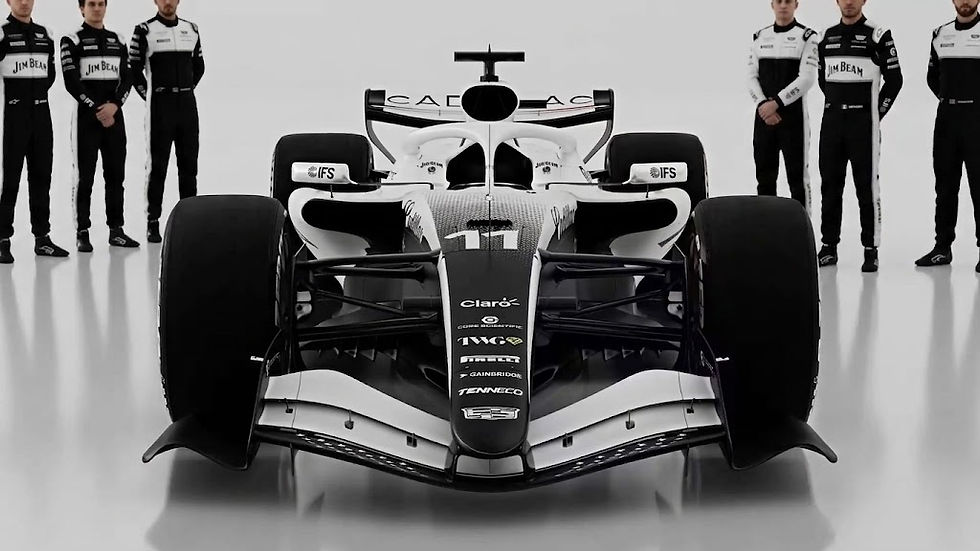
The resolution came with a steep price tag. For the 2026 entry, General Motors (Cadillac) agreed to pay an anti-dilution fee of $450 million. This figure serves two purposes:
Compensation: It compensates the existing ten teams (at $45 million each) for the temporary loss of prize money share.
Valuation Anchor: It sets a hard floor for the value of a team. If a paper entry costs $450 million, an operational team with factories and staff is worth significantly more.
As Audi prepares to enter the grid in 2026 by taking over Sauber, and Cadillac builds its operation from scratch, the grid is now composed entirely of well-capitalized franchises and major OEMs.
2026 and Beyond: The New Economic Reality
As the sport heads into the new regulatory era of 2026, the financial architecture has solidified. The signing of the new Concorde Agreement by all teams guarantees stability through 2030.
The era of the "garagista"—the privateer team surviving race-to-race—is over. In its place is a landscape of billion-dollar sports properties where financial efficiency is as celebrated as aerodynamic efficiency. While the prize money distribution remains skewed toward the historic "aristocracy" through the LST and CCB bonuses, the rising tide of global revenue and the safety net of the cost cap have ensured that for the first time in history, every car on the grid is driving for a profitable business.
For McLaren, the back-to-back titles in '24 and '25 represent a sporting triumph, but for the grid as a whole, the real victory has been the construction of an economic fortress that turns high-speed competition into a high-yield asset class.
Additional articles on F1 Team Finances and Economics
Additional articles on F1 Rules and Governance


Comments