


The $8 Million Secret Buried in F1's 2026 Rules
Updated: Jan 3
In the ruthless meritocracy that defines Formula One, the historic maxim has always been simple: build a fast engine, or perish. For decades, the sport has operated on a Darwinian economic model. If a manufacturer arrived at the first race of a new era with a horsepower deficit, they paid a double penalty—the humiliation of defeat on Sunday, followed by the financial burden required to fix the mess on Monday.
But as the sport moves toward the 2026 regulatory reset, that maxim has been quietly rewritten. Buried deep within the hundreds of pages of the newly published Financial, Technical, and Operational Regulations is a mechanism that fundamentally alters the DNA of the sport. It is formally known as Additional Development and Upgrade Opportunities (ADUO).
For the first time in history, Formula One has legislated a safety net for engineering failure. Through a complex algorithmic trigger, the sport has created a system where falling behind the pack unlocks a treasure chest of financial credits and dyno hours. It is a radical departure designed to protect the massive investments of newcomers like Audi and Ford, but it introduces a perverse incentive structure that may inadvertently reward the art of "sandbagging."
From Sakura to 2026: How One Disaster Changed the Rules Forever
To understand why the FIA and the existing manufacturers agreed to the ADUO mechanism, one must look back a decade to a traumatic corporate failure in F1 history: the Honda return of 2015.
When Honda reunited with McLaren at the dawn of the hybrid era, the anticipation was immense. The reality, however, was catastrophic. The Honda RA615H power unit was unreliable, underpowered, and fundamentally flawed in its architecture. But the tragedy of Honda wasn’t just that the engine was slow; it was that the regulations of the time actively prevented them from fixing it.
The 2015 regulations utilized a restrictive "token system" that strictly limited how many parts of the Power Unit (PU) could be redesigned in a season. Honda had the money to fix their problems, and they had the engineering talent, but they were legally barred from changing the hardware fast enough to save their reputation. They were trapped in a regulatory straightjacket while Fernando Alonso famously screamed "GP2 Engine!" on global television.
The reputational damage was incalculable. It took Honda five agonizing years to recover.
Fast forward to the negotiations for the 2026 cycle. Formula One has successfully courted two massive new OEMs: Audi, who is building a bespoke engine from scratch in Neuburg, and Ford, partnering with Red Bull Powertrains to build their first-ever in-house hybrid unit.
Neither the board in Ingolstadt nor the executives in Dearborn were willing to sign off on billions of dollars in investment if there was a risk of a "Honda 2015" scenario. They needed insurance. They needed a guarantee that if they got the complex 50/50 internal combustion/electric split wrong in year one, they wouldn’t be locked into a cycle of failure until 2030.
The ADUO is that insurance policy. It is a direct legislative response to the trauma of the token era. It acknowledges that the 2026 Power Unit—with its removal of the MGU-H and massive increase in electrical dependence—is an engineering minefield. The FIA has effectively decided that having six healthy, competitive manufacturers is more valuable to the commercial health of the sport than the strict preservation of engineering meritocracy.
The "2% Rule": How Losing Unlocks $8 Million in Free Budget
So, how does this safety net function?
Unlike the subjective "Balance of Performance" (BoP) seen in endurance racing, where officials arbitrarily add ballast or restrict air restrictors to slow down the leaders, the ADUO is an algorithmic subsidy for the losers.
The mechanism relies on the internal combustion engine (ICE) Performance Index. During three specific windows in the season (Rounds 1-6, 7-12, and 13-18), the FIA will calculate a performance average for every Power Unit on the grid. If a manufacturer falls behind the class leader by a margin of 2% or greater, the safety net deploys automatically.
The subsidies are dispensed in three currencies: Money, Time, and Opportunity.
Money: The Financial Credit (Raising the Cap)
The baseline Cost Cap for Power Unit Manufacturers in 2026 is $190,000,000. However, Article E4.1.1.t of the Financial Regulations dictates that if a manufacturer triggers the ADUO, they are granted a "downward adjustment" to their relevant costs. In layman's terms, this is a credit line that allows them to spend above the cap.
The scale is progressive:
2% to < 4% Deficit: A $3,000,000 credit.
4% to < 6% Deficit: A $4,650,000 credit.
6% to < 8% Deficit: A $6,350,000 credit.
> 8% Deficit: An $8,000,000 credit.
For a manufacturer in deep crisis (a 8% or greater deficit), this is transformative. An extra $8 million represents roughly 4% of the total budget—enough to fund a complete redesign of the cylinder heads, a new combustion concept, or an emergency task force of contractors.
Time: The Operational Bonus
In modern F1, money is useless without the time to validate designs. The 2026 regulations are incredibly strict on "Test Bench" (dyno) usage, capping the leader to roughly 710 hours of high-rev running per year.
However, Article F5.2.7 of the Operational Regulations throws the doors open for the laggards. The regulations grant increases in "ICE Operation Hours" (running the engine on the dyno >7500rpm) to underperforming manufacturers. A manufacturer with a severe deficit (8% or greater) is granted 190 extra hours of dyno time per period.
The "Catch-Up" hours per period:
< 2%: 0 extra hours.
2% to < 4%: 70 extra hours.
4% to < 6%: 110 extra hours.
6% to < 8%: 150 extra hours.
≥ 8%: 190 extra hours.
Opportunity: The Technical Unlock
Finally, Section C - Technical Regulations (Appendix C5) relaxes the homologation freeze. While the leader is restricted to one specification upgrade per year, an ADUO-eligible manufacturer is granted additional upgrade slots. This allows them to bring iterative fixes to the track immediately, rather than waiting for the next season.
Strategic Deception: The Hidden Incentive to Hide True Horsepower in 2026
While the ADUO was designed to save the sport from losing a manufacturer, it introduces a dangerous new variable to the competitive landscape: Strategic Performance Management (“Sandbagging").
Consider the mathematics of the 2% threshold. It creates a binary cliff edge. If a rival manufacturer is 1.99% slower than you, they receive nothing. They must fix their engine within the standard cap and standard hours. But if they are 2.01% slower than you, they are suddenly handed $3 million and 70 hours of free dyno time. This creates a perverse incentive for the class leader.
Let’s hypothesize a scenario in 2026: Mercedes produces a rocket of an engine. They are clearly the class of the field. Red Bull-Ford is struggling, hovering around a 1.8% performance deficit.
If Mercedes pushes their advantage to the absolute limit—turning up the engine modes to maximum power during the first six rounds—they might widen the gap to Red Bull to 2.2%. In doing so, they inadvertently trigger the ADUO clause for their rival. By being too dominant, Mercedes would legally empower Red Bull with the financial and operational tools to catch them.
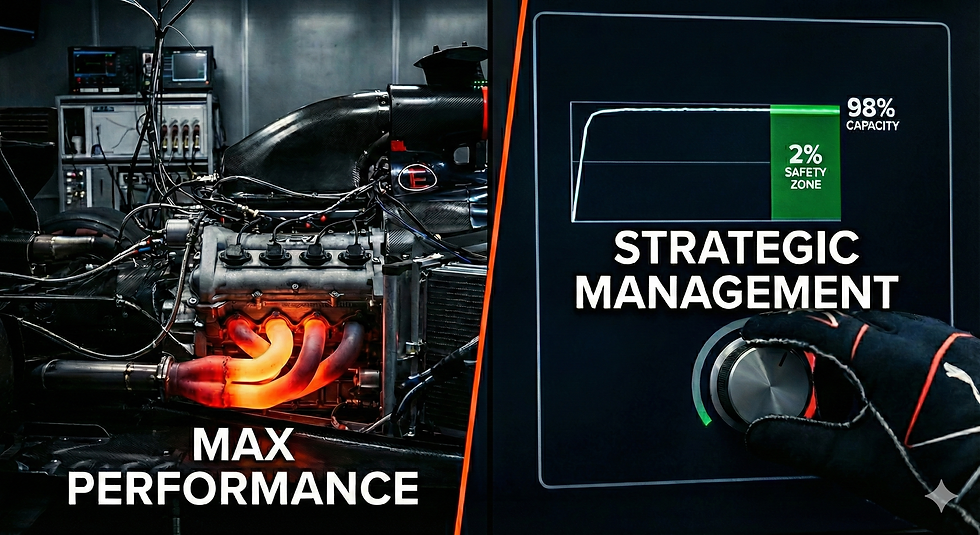
Therefore, the smartest strategy for Mercedes is not to dominate, but to manage. The optimal play is to run the engine at 98% capacity—just fast enough to win, but slow enough to keep the second-fastest manufacturer within the 2% "safe zone."
This introduces "rubber-banding"—a mechanic usually found in arcade racing games like Mario Kart—into the pinnacle of motorsport. It incentivizes the leader to hide their true pace, distorting the competitive picture for fans and sponsors. Qualifying sessions could become a dark art of delta management, where engineers are terrified of setting a lap time that is "too fast."
Escaping the $190M Ceiling: The Secret Credit Line for Struggling Teams
From a purely financial perspective, the ADUO mechanism offers a fascinating loophole for CFOs.
The $190M Power Unit Cost Cap is tight. It requires painful efficiency measures, potentially involving staff reductions or the shuttering of expensive testing facilities. However, the ADUO credit is not ring-fenced for "parts manufacturing." It is a general downward adjustment of Relevant Costs.
This means a manufacturer who triggers the clause effectively gets a buffer to cover their overheads. If Audi, for example, finds themselves 5% off the pace, they qualify for a ~$4.6M credit. That credit absorbs costs that would otherwise count against the cap—salaries of high-end simulation engineers, facility electricity bills, or software licenses.
In a perverse twist, a manufacturer might find that triggering the ADUO clause creates a healthier operational balance sheet than narrowly missing it. Staying just inside the competitive window (e.g., 1.9% deficit) forces you to spend the full $190M to bridge the gap with zero assistance. Falling outside the window (e.g., 2.1% deficit) grants you subsidy.
The CFO of a midfield manufacturer might quietly prefer the deficit. It relieves the pressure to cut costs elsewhere in the business to fund the recovery.
A New Era of Managed Competition
The 2026 Financial Regulations mark the end of the "brute force" era of Formula One engineering. The ghosts of Honda's past have been exorcised, but in their place, a new spectre has been raised.
The ADUO mechanism is a system built on pragmatism. It exists to ensure that no board of directors will ever again have to pull the plug on an F1 program because of a single failed design concept. It guarantees that Audi and Ford will remain on the grid, fighting their way back to the front with state-subsidized development curves.
But the cost of this safety net is the purity of the competition. We are entering an era where the leader is disincentivized from showing their full hand, where failure is met with a financial reward, and where the stopwatch is no longer the only arbiter of development potential.
In 2026, the race will not just be to the checkered flag. It will be a race to the 1.99% margin—the sweet spot where you are fast enough to win, but not fast enough to help your enemies.
Additional articles on F1 Team Finances and Economics
Additional articles on F1 Rules and Governance


Comments