


The $1 Billion Gamble: Why LVMH’s Monopoly May Be the Best Thing to Ever Happen to Formula 1 Teams
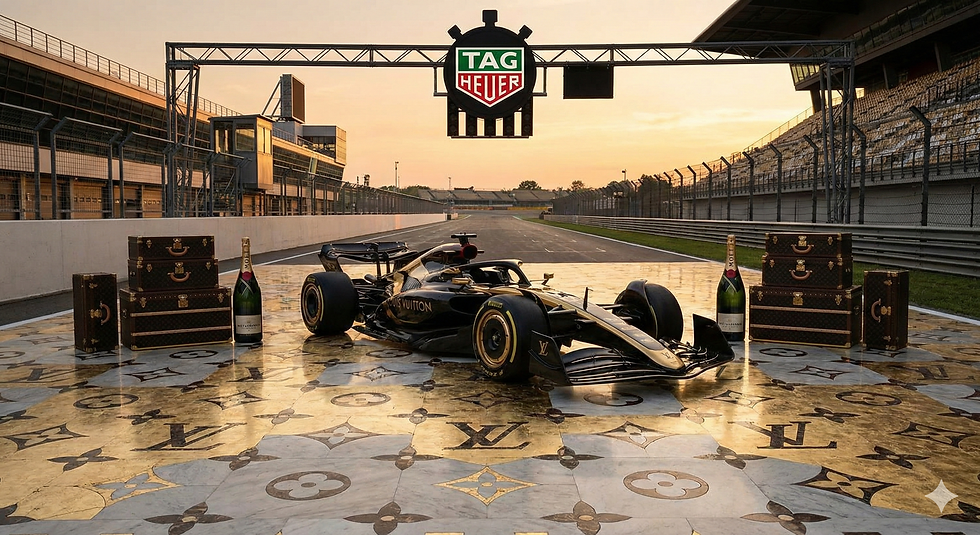
Bernard Arnault has just turned the Formula 1 paddock into a 200-mph luxury showroom. By signing a historic $1 billion, ten-year deal, LVMH has effectively seized control of the sport’s most prestigious real estate—the podium toast, the official timekeeping, and the very trunks that carry the trophies. To the cautious observer, this looks like a "commercial cannibalization" that should leave individual teams like McLaren and Ferrari starving for their own luxury partners. Yet, the data reveals a startling paradox: despite LVMH’s total dominance, team sponsorship revenue has surged to $2.9 billion, and the "floor" for prize-fund distributions has never been higher. This article explores how Liberty Media’s "closed-garden" strategy has created an era of artificial scarcity, making the remaining assets on the grid more valuable than ever before.
Liberty Media, the commercial rights holder, has effectively transformed the paddock into a closed-garden luxury ecosystem. The replacement of piecemeal sponsorships—Rolex, Ferrari Trento, and various fashion activations—with a monolithic, multi-maison deal involving Louis Vuitton, Moët Hennessy, and TAG Heuer has raised critical questions about inventory cannibalization. Are teams losing the ability to monetize their own luxury assets? The evidence suggests a complex reality where team autonomy is being tested, yet paradoxically, the value of the entire grid is rising.
The New Commercial Monolith
The sheer scale of the LVMH partnership dwarfs previous commercial benchmarks. Valued at approximately $100 million annually, the deal integrates three of LVMH’s most potent verticals directly into the sport’s infrastructure. Louis Vuitton has assumed the role of Title Partner for the season-opening Australian Grand Prix (Formula 1 Press Release, February 2025) and continues to craft bespoke trophy trunks for the podium. Moët Hennessy has replaced Ferrari Trento as the Official Champagne, reclaiming the podium toast with its iconic Moët & Chandon label. Perhaps most significantly, TAG Heuer has displaced Rolex as the Official Timekeeper, ending the Swiss giant’s 11-year reign over the trackside clocks.
For Liberty Media, this is an exercise in revenue aggregation. By bundling these rights, they have secured a long-term, high-value revenue stream that contributes significantly to the sport’s primary revenue, which reached record highs of $3.4 billion (Liberty Media, February 2025). However, for the eleven independent racing franchises, this centralization presents a theoretical threat: the "cannibalization" of sponsorship categories. If the league sells the exclusive rights to "Timekeeping" and "Champagne" to a global giant, what is left for the teams?
The Watch Wars: Centralization vs. Team Heritage
The displacement of Rolex by TAG Heuer is the most contentious element of the new era. Rolex had been a ubiquitous presence since 2013, spending an estimated $50 million annually (beyondtheflag.com, July 2024). Its departure left a vacuum, but LVMH’s entry with TAG Heuer created a unique friction point: TAG Heuer was already, and remains, a title sponsor of Red Bull Racing.
In a move that defied traditional conflict-of-interest norms, TAG Heuer renewed its partnership with Red Bull Racing through 2025 and beyond. This created a scenario where the "Official Timekeeper" of the league is simultaneously a sponsor of one specific competitor. While uncommon, this alignment suggests that LVMH views team sponsorship and league sponsorship as complementary rather than mutually exclusive.
However, the impact on rival teams is palpable. The "Clean Venue" policy enforced by Formula 1 ensures that trackside camera angles are dominated by Global Partners. For Mercedes-AMG Petronas, whose long-standing partnership with IWC Schaffhausen is a pillar of their commercial portfolio since 2013 (Mercedes-AMG Petronas, February), the LVMH deal means their partner is visually drowned out by TAG Heuer branding on the global feed. Similarly, Aston Martin’s partner Girard-Perregaux and Ferrari’s partner Richard Mille face a diluted share of the spotlight.
Despite this, the fear that teams would be unable to sign watch sponsors has proven unfounded. In fact, the exclusivity of the Global Partner tier has forced competing watch brands to retreat to the teams to maintain any presence in the sport. A prime example is Tudor, the sister brand of the ousted Rolex. Rather than leaving the sport, Tudor doubled down on its partnership with the Visa Cash App RB (VCARB) team, with its branding appearing prominently on the rear wing for the 2025 season (Tudor Watch, February 2026). This suggests a "fortress" strategy: locked out of the league-wide assets, competitors are entrenching themselves with specific teams to reach the audience.
The Celebration Economy: Spirits and the Podium Monopoly
The alcohol category presents a more direct conflict. The return of Moët & Chandon to the podium means that the defining image of victory—the champagne spray—is exclusively an LVMH moment. For teams with their own spirits partners, this creates a "glass ceiling" on visibility.
Ferrari (Scuderia Ferrari HP) signed a multi-year partnership with Chivas Regal, a Pernod Ricard brand, ahead of the Las Vegas Grand Prix in late 2024 (Ferrari, November 2024). This deal highlights the nuances of the new landscape. While Chivas Regal cannot be sprayed on the podium, it can be visible in the team's private hospitality suites and through digital content.
Similarly, McLaren Racing extended its partnership with Jack Daniel’s in late 2024, continuing a relationship that features branding on the car nose and driver overalls (sbnation.com, September 2025). The resilience of these deals proves that the LVMH league-wide exclusivity has not cannibalized team inventory in the legal sense. Teams retain the right to sell "Official Spirits Partner" designations. However, the value of those designations changes. A team sponsor can no longer promise their bottle will be seen in the winner's hand on the world feed; they must instead rely on the team's own marketing channels and the "cool factor" of the driver.
Financial Flows: The Concorde Agreement as a Buffer
To understand why teams agreed to a deal that visually prioritizes LVMH, one must look at the bottom line. The commercial structure of Formula 1 is governed by the Concorde Agreement, the tripartite contract between the FIA, Formula 1, and the teams. The 2026 Commercial Concorde Agreement, signed by all teams in March 2025, codified the financial distribution for the next cycle.
Under this agreement, teams receive a percentage of the sport's commercial profits. The $1 billion LVMH deal flows directly into this prize fund pot. For a mid-field team like Williams or Haas, the revenue share from this global deal likely exceeds what they could generate by selling a lower-tier watch or champagne sponsorship on their own.
The injection of LVMH capital raises the "floor" of team revenue. It allows teams to be more selective. McLaren CEO Zak Brown, whose team generated a record $614 million in revenue in 2024 (Forbes, November 2025), has argued that high-tide global deals validate the sport's premium demographic, allowing teams to charge more for their remaining inventory. "We have the most amount of commercial revenue that a racing team has ever had," Brown stated in February 2025 (SportsPro, February 2025), proving that the LVMH deal did not stifle his team's ability to sign partners like Mastercard, Google, and Jack Daniel's.
The "Restrictive" Strategy and Scarcity Value
Jonny Haworth, F1’s Director of Commercial Partnerships, has been transparent about Liberty Media’s strategy. "We’re quite restrictive at the top end of the scale to make sure there’s that value of exclusivity," Haworth explained (BlackBook Motorsport, November 2025). By capping the number of Global Partners at around 11 (including LVMH, Aramco, American Express, etc.), F1 creates artificial scarcity.
This scarcity forces brands that cannot afford the $100 million league-entry price—or are locked out by category exclusivity—to spend with the teams. Ampere Analysis estimates that sponsorship spend across F1 and its teams reached $2.9 billion in 2025, a 10% increase year-over-year (Ampere Analysis, March 2025). Teams account for 72% of this total revenue. This data point is critical: despite the massive LVMH deal at the top, the vast majority of sponsorship dollars are still flowing to the teams. The "cannibalization" theory is not supported by the macroeconomic data; instead, the market is expanding.
Case Study: McLaren and the "Rumored" Exits
The limits of this expansion are being tested at McLaren. The team's partnership with Richard Mille, a staple of their commercial portfolio since 2016, is nearing a critical juncture. While the original 10-year deal secured in 2016 runs through the 2025 season (Crash.net, March 2022), speculation is rife about its renewal. Richard Mille also sponsors Ferrari (since 2021), creating a split focus. During the January 2026 shakedown test in Barcelona, both McLaren and Ferrari cars displayed Richard Mille advertising.
With LVMH controlling the timekeeping narrative via TAG Heuer, Richard Mille’s hyper-expensive, technical positioning becomes even more vital as a counter-narrative. They are not competing for mass awareness (TAG Heuer’s lane); they are competing for the ultra-high-net-worth individual who buys a $300,000 watch. This segmentation suggests that niche luxury brands will continue to thrive on team liveries, while mass-market luxury brands consolidate at the league level.
A Rising Tide with Navigational Hazards
The LVMH-Formula 1 partnership is a defining moment in the "Americanization" of the sport’s business model. Liberty Media has successfully monetized the league's IP at a level previously unimagined. For the teams, the deal presents a trade-off: they have lost the ability to offer partners the "total dominance" of a race weekend, as LVMH now owns the clocks, the podium, and the trophy presentation.
However, the teams have not lost the ability to sign luxury partners; they have simply had to refine the value proposition. The continued presence of Chivas Regal at Ferrari, Jack Daniel's at McLaren, and Tudor at VCARB proves that the ecosystem is robust enough to support competing brands. The "cannibalization" is purely optical; financially, the teams are beneficiaries of the LVMH deal through the Concorde Agreement's revenue-sharing mechanisms.
As the 2026 season dawns, Formula 1 has become a "Mall of Luxury" anchored by LVMH, with the teams operating as thriving boutique flagships within it. The inventory has not been eaten; it has been rezoned.
Additional articles on F1 Team Finances and Economics
Additional articles on Liberty Media's Finances & Economics


Comments