


The €481 Million Formula 1 Illusion: Who Pays for Madrid’s Race?

When regional politicians promised that "not a single euro of public money" would bankroll Madrid’s new Formula 1 Grand Prix, they counted on private investors rushing to pick up the tab. Instead, when the private tender collapsed with zero bids, public balance sheets quietly absorbed a staggering €481.5 million commitment—including an unprecedented €48 million annual sanction fee paid straight to Liberty Media. Strip away the inflated economic multiplier models, and Madrid has not outnegotiated European motorsport; it has trapped its own taxpayers into underwriting the most expensive commercial gamble on the 24-race calendar.
Across its contractual life, this commitment reflects €277 million in base competition rights obligations coupled with €4.5 million in municipal destination marketing packages (Demócrata, September 10, 2026). This analysis examines the financial and operational mechanics of the Madrid race: how Formula 1 leveraged Madrid's commercial entrance to establish a lucrative European pricing benchmark, why headline macroeconomic projections conflate external capital injection with local consumption displacement, and how the failure of private concession tenders transferred immense fiscal liabilities back onto public balance sheets.
Commercial Pricing Power and the Bifurcation of Spain’s Motorsport Corridor
Rather than outright displacing the Circuit de Barcelona-Catalunya, which has staged Formula 1 uninterrupted since 1991, Formula 1 harnessed Madrid’s bid to orchestrate a strategic bifurcation of the Spanish market. Formula 1 secured an unprecedented dual-race calendar for Spain in 2026—holding Barcelona on June 12–14 followed by Madrid's debut on September 11–13.
Under a formal restructuring announced on February 16, 2026, Barcelona agreed to a contract extension through 2032 that incorporates a biennial rotation mechanism with Belgium's Circuit de Spa-Francorchamps (Motorsport.com, February 16, 2026. Under this framework, Madrid captures the prestigious, perpetual "Spanish Grand Prix" moniker, whereas Montmeló stages the "Barcelona-Catalunya Grand Prix" strictly during even-numbered years (2028, 2030, 2032) alternating with Spa-Francorchamps in odd-numbered years (2027, 2029, 2031).
Formula 1 Chief Executive Stefano Domenicali framed this escalation as proof of European market capacity, stating:
"At a moment where Europe is perceived to be a place that is not ready to invest in our sport, Madrid and others are showing it is" (The Guardian, January 23, 2024).
This aggressive commercial stance was underpinned by corporate commitments, including Banco Santander joining as sole Founding Partner and Match Hospitality deploying €400 million in VIP hospitality infrastructure (Banco Santander, 2026; MADRING March 10, 2025). By establishing an alternate, premium revenue hub in Madrid, Formula 1 demonstrated that legacy European circuits unwilling or unable to fund escalating sanction fees must submit to calendar-sharing models to retain a presence on the 24-race global calendar.
Deconstructing the €467 Million Projections: Multipliers vs. Consumption Displacement
The central economic justification advanced by regional authorities relies heavily on an economic impact evaluation conducted by PricewaterhouseCoopers (PwC), which projects an annual gross economic return of €467 million, 8,850 direct and indirect jobs, and approximately €83 million in cumulative tax receipts (Sector, July 30, 2026). IFEMA MADRID Chairman José Vicente de los Mozos argued this study validates the project, noting that:
"For every euro of economic activity directly linked to the Formula 1 Spanish Grand Prix, around €3.90 is generated across the wider Madrid economy" (Sports Tourism News, August 19, 2026).
PwC GROSS REGIONAL IMPACT MODEL (€467M TOTAL) | |
DIRECT ECONOMIC ACTIVITY: €273M | INDIRECT / INDUCED: €194M |
|
|
However, methodological scrutiny reveals a critical vulnerability: the published data aggregates direct, indirect, and induced economic ripples without isolating net-new foreign capital inflows from domestic spending. Of the 120,000 grandstand and hospitality tickets sold, genuine external demand is confined to 45,000 international attendees and roughly 35,000 visitors originating from other Spanish autonomous communities (Demócrata, September 10, 2026).
These 80,000 visiting spectators drove undeniable pricing power: hotel commerce platform SiteMinder recorded average daily rates surging 69.6% year-over-year to €485 per night, while flight booking platforms confirmed significant spikes in inbound traffic from the UK (+46%), South Korea (+45%), and France (+32%) (Demócrata, September 2026).
Conversely, the remaining ~40,000 tickets were purchased by residents of the Madrid metropolitan area. In macroeconomic accounting, resident consumption cannot be treated as net-new wealth; it represents consumption displacement—diverting household discretionary capital from neighborhood businesses into race-week operations. Furthermore, pricing friction emerged when hospitality partners released thousands of pre-blocked hotel rooms back into the retail market two weeks before the race, depressing peripheral hotel occupancy to 70% despite inflated rack rates (Demócrata, September 2026). PwC Economics Lead Partner Jordi Esteve acknowledged these boundaries, stressing that:
"Preliminary estimates suggest the Formula 1 Spanish Grand Prix in Madrid will have a very significant capacity to generate socio-economic value... It is important to underline that this remains a preliminary assessment... Once the event has taken place, a further study will be conducted to validate these forecasts" (Sector, July 30, 2026).
Infrastructure Optimization and Civil Engineering Execution
To contain civil capital expenditures, circuit designers Studio Dromo and the Tilke Group adopted a semi-permanent configuration that capitalized on existing exhibition fairgrounds (RacingCircuits.info, 2026). Constructing a permanent purpose-built circuit typically demands hundreds of millions of euros; in contrast, IFEMA awarded the civil construction package to the Acciona Construcción and Eiffage Construcción joint venture for €83.2 million (MADRING Official Press Release, April 2025).
MADRING CIRCUIT PROFILE (5.416 KM) | |
PERMANENT FAIRGROUND SECTION | SEMI-PERMANENT URBAN SECTION |
|
|
The facility's engineering centerpiece is Turn 12 ("La Monumental"), an aggressive 550-meter, 270-degree right-hand sweep boasting a 24% incline and 13.5 degrees of lateral banking, requiring 700,000 tons of earthworks (Economía Digital, September 12, 2026). Grand Prix Ambassador Carlos Sainz projected its tactical significance:
"It looks impressive because we're going to be entering that corner at a very high speed, around 180-200km/h [112-124mph]. My feeling is the corner is going to be flat out the whole way, and it's going to create an overtaking opportunity in the next left" (The Race, 2026).
To secure FIA Grade 1 certification across extreme lateral forces, safety contractor Geobrugg installed a world-first safety system on Turn 12, anchoring mobile debris fences perpendicular to the 24% banked asphalt using custom anchor pins alongside DELTABLOC barriers and SAFER foam attenuators (Sector, August 28, 2026). While technical optimization successfully limited baseline civil CapEx, it did not resolve the broader commercial risks associated with promoter liabilities.
The Risk Transfer Breakdown: Public Balance Sheet Exposure
Despite public assurances that private capital would underwrite the event, public procurement filings disclose substantial taxpayer exposure (La Razón, January 31, 2024; EuroMotor, September 2026). Throughout the project's launch, Community of Madrid President Isabel Díaz Ayuso maintained that "not a single euro of public money" would be deployed, contrasting Madrid’s model with the €40 million in historic public subsidies received by Barcelona (Demócrata, September 2026).
IFEMA MADRID PUBLIC EQUITY STRUCTURE (62%) | |
PUBLIC STAKEHOLDERS | PRIVATE / CIVIC STAKEHOLDERS |
• Community of Madrid: 31%• Madrid City Council: 31% | Madrid Chamber of Commerce: 31% Montemadrid Foundation: 7% |
TOTAL DIRECT PROJECT OUTLAYS: €188M+CONTRACTUAL BREACH / CANCELLATION CONTINGENT LIABILITY: €270M | |
The mechanism intended to insulate taxpayers was an international public tender issued by IFEMA to recruit an external private operator to run race operations, market hospitality, and absorb operating shortfalls. However, that tender attracted zero qualifying private sector bids and was formally declared void ("quedó desierto") (GandPrix.com September 25, 2024).
Because IFEMA MADRID is a consortium with 62% public equity ownership divided equally between the Community of Madrid (31%) and the Madrid City Council (31%), the voided tender forced IFEMA to internalize operational and financial exposure (EuroMotor, September 2026). Official corporate records reveal that the public entity directly committed over €188 million in project-related capital outlays while registering up to €270 million in contingent liabilities for contractual breach or cancellation under the 10-year Formula 1 accord (EuroMotor, September 2026).
Opposition party Más Madrid detailed a cumulative 10-year public exposure reaching €481.5 million—aggregating €200 million in civil circuit infrastructure, €277 million in Formula 1 sporting rights, and €4.5 million for municipal branding (Demócrata, September 10, 2026). Regional parliamentary figures, including Rita Maestre and Mónica Oltra, warned that the structure risks replicating the financial collapse of the Valencia Street Circuit, which accumulated €300 million in unpaid municipal debt after hosting the European Grand Prix from 2008 to 2012 (Demócrata, September 2026). Simultaneously, civic groups mounted legal challenges alleging municipal transit and land subsidies breach EU State Aid provisions under Article 107.1 of the Treaty on the Functioning of the European Union (Público, September 2026).
Strategic Benchmark: Macroeconomic Models Across European Venues
The commercial vulnerability of European race promotion is underscored when benchmarking MADRING against other continental circuits navigating Formula 1's pricing landscape:
(Traditional Permanent Facility) | Annual Race Sanction Fee | Ten-Year Contractual Status & Horizon |
MADRING (IFEMA Madrid) (Semi-Permanent Urban Hybrid) | Est. €48.0M per race; €277M over 10 yrs (Demócrata, September 10, 2026) | 10-year fixed tenure (2026–2035); stages official Spanish Grand Prix (The Guardian, January 23, 2024) |
Circuit de Barcelona- Catalunya (Traditional Permanent Facility) | Est. €25.0M–€30.0M per edition (Motor Sport Magazine, May 28, 2025) | Calendar rotation with Spa-Francorchamps; hosts even years through 2032 (Motorsport.com, February 16, 2026) |
Circuit de Spa-Francorchamps (Traditional Permanent Facility) | Est. €22.0M–€25.0M per edition (Sports Illustrated February 10, 2024) | Calendar rotation with Barcelona; hosts odd years through 2031 (Motorsport.com, February 16, 2026) |
Circuit Zandvoort (Traditional Permanent Facility) | Est. €32.0M+ per race (RacingNews365 January 22, 2022) | Exited Formula 1 calendar after 2026 due to a lack of public financing (EuroMotor, September 2026) |
The departure of Circuit Zandvoort reinforces the macroeconomic rule governing modern European sports promotion: without substantial public capital underwriting, escalating commercial fees render private circuit operation financially untenable. IFEMA MADRID managed to bridge this commercial divide, but only by assuming the exact state-backed exposure that regional policymakers originally pledged to circumvent (Demócrata, September 2026).
Formula 1 Wins While Madrid Holds the Bill
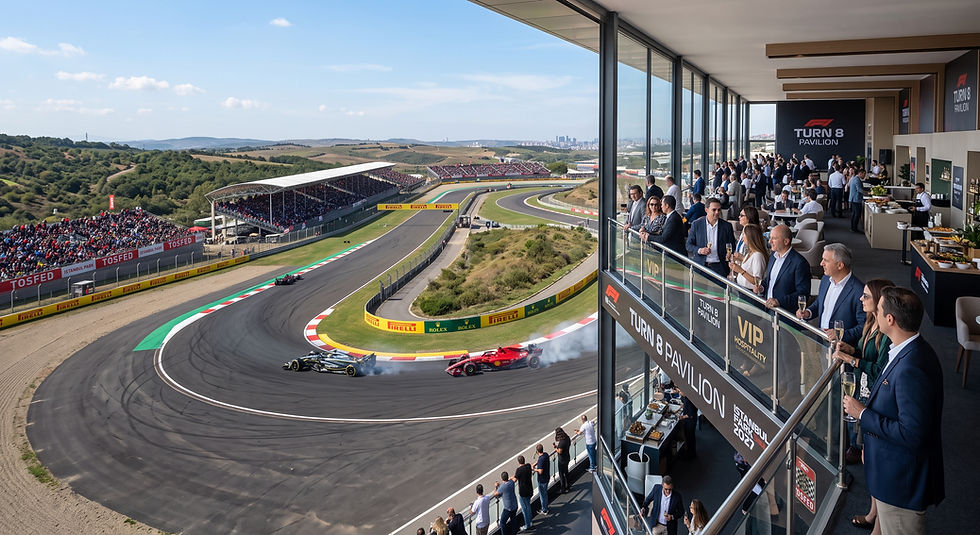
Formula 1 achieved exactly what it came for: a record-breaking €48 million annual fee benchmark in Western Europe, total leverage over historic tracks in Barcelona and Spa, and an undeniable civil engineering showcase. But behind the champagne in the VIP suites, the financial arithmetic is merciless. When the concession tender went to open market, not a single private operator was willing to touch the risk. That leaves a 62% publicly owned entity holding €270 million in breach liabilities and betting €481.5 million of civic wealth that foreign tourists will balance the ledger. In modern Grand Prix racing, Liberty Media cashes the checks, politicians take the bows—and the taxpayer is left sweeping the track.

Comments