


Inside the $36M Sovereign Gamble Backing Formula 1's Return to Turkey
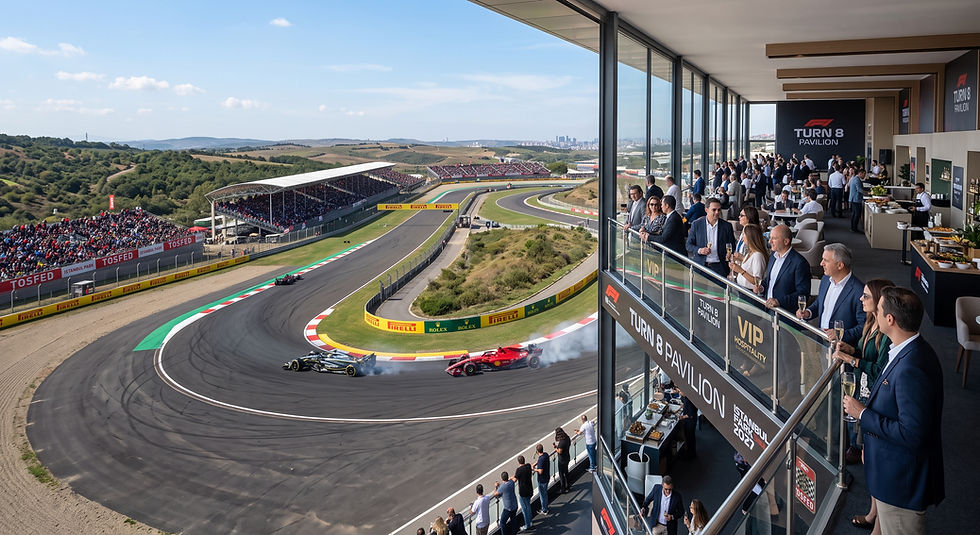
Private promoters went broke trying to keep Formula 1 in Istanbul, leaving behind broken leases, empty grandstands, and an exasperated commercial rights holder. But when the world’s most lucrative motorsport championship returns to Istanbul Park in October 2027, it won’t rely on gate receipts to survive. Backed by a direct $36 million annual sovereign guarantee from the Turkish state, Istanbul is discarding the fragile private-concession model that doomed its past and replacing it with an aggressive corporate blueprint: guaranteed state underwriting, a doubled paddock footprint, and five-figure VIP suites built over the legendary Turn 8. Here is how Turkey restructured a financially broken Grand Prix into an ironclad masterclass in modern sports capitalism.
This return addresses the institutional instabilities that previously removed Istanbul Park from the world championship schedule after the 2011 season. Historically, host venues have struggled when operating purely under private speculative leaseholds without direct sovereign coordination. In the modern era of Formula 1 under Liberty Media—where hosting rights are fiercely contested among global capitals and high-yield entertainment epicenters—securing a sustainable five-year tenure demands operational rigor, capital-intensive infrastructural modernization, and direct sovereign balance-sheet backing.
Restructuring Istanbul’s Promotion and Risk
The primary catalyst for the multi-year rehabilitation of the Turkish Grand Prix lies in the total reconstitution of its legal and regulatory architecture. Istanbul Park, a 2.21-million-square-meter facility located in the Tuzla district on the southeastern periphery of Istanbul, was leased and managed for more than a decade by the private automotive leasing concessionaire Intercity.
When Intercity’s contractual lease expired, the property owner—the General Directorate of Foundations (Vakıflar Genel Müdürlüğü)—conducted a formal commercial tender on April 2, 2024 (Motorsport.com Turkey, April 2, 2024). The tender resulted in a 30-year operational lease valued at $117.8 million awarded to Can Bilim Eğitim Kurumları A.Ş., an enterprise part-owned by Pirelli Turkey Chairwoman Lale Cander (RacingNews365, April 3, 2024). At the time of the award, Cander projected an aggressive timeline, asserting:
"Istanbul Park track will be a centre of attraction. Formula 1 is extremely prestigious, and it increases the prestige of the country. There will be countries that will be removed from the calendar in 2026, so races can be held again in Turkey. Apart from Formula 1, we will bring other races to Istanbul Park" (RacingNews365, April 3, 2024).
The initial tender imposed strict stipulations requiring the concessionaire to secure a binding Formula 1 calendar slot by 2026 under threat of steep contractual non-compliance penalties (RacingNews365, April 3, 2024; Hürriyet Daily News, April 3, 2024). However, multilateral negotiations between private commercial stakeholders and Formula One Management (FOM) stalled during early 2025. When initial talks convened in London, commercial rights holders expressed reluctance rooted in historic execution deficits. As TOSFED President Eren Üçlertoprağı detailed regarding the initial posture of international rights holders:
"When I attended the first meeting in London at the beginning of last year, I was met with statements like, 'We don't want to come to Türkiye for a long time.'" (Motorsport.com Turkey, April 25, 2026).
Recognizing that private concession structures lacked the institutional balance sheet required by Liberty Media, the Turkish government intervened. On June 16, 2025, operating rights over the Tuzla complex were formally transferred away from private operators and vested directly in TOSFED (Şalom Gazetesi, June 25, 2025).
Table 1: Sovereign Underwriting and Administrative Governance Hierarchy
Governance Tier | Institutional Entity | Regulatory Mandate & Operational Scope | Financial & Legal Mechanism |
Sovereign Authority | Turkish Presidency / Ministry of Youth & Sports / Ministry of Culture & Tourism | Executive sponsorship, macroeconomic alignment, inter-agency municipal coordination | Full statutory backstop and payment guarantee insulating hosting fees against commercial default |
Delivery & Sporting Host | TOSFED (National Sporting Authority / ASN) | Facility operations, local event promotion, track homologation, grassroots and support-race programming | Exclusive master operational leaseholder under direct ministerial supervision; binding delivery counterparty |
Championship Rights Holder | Formula One Management (FOM) / FIA | Global sporting regulation, broadcast distribution, commercial rights management | 5-Year World Championship Calendar Agreement (2027–2031) ratified for a guaranteed 24-race slot |
To eliminate private solvency risks, the Turkish state deployed a sovereign guarantee model encompassing the Ministry of Youth and Sports and the Ministry of Culture and Tourism (Motorsport.com, July 29, 2025). Outlining this shift, Üçlertoprağı confirmed:
"Following our appointment by the government as the federation a few months ago, we have been in intensive discussions with F1 and FIA management... I am happy to say that, thankfully, our president, minister of culture and tourism, and minister of youth and sports are all seriously supporting the project to bring Formula 1 back to Turkey. Therefore, we are currently receiving significant support and encouragement from our government. All payments and procedures related to the race will be completed under state guarantee" (Motorsport.com, July 29, 2025).
Under this sovereign mechanism, annual licensing fees—estimated in preliminary municipal and tender documentation at approximately $36 million per year—are formally guaranteed by the Turkish state (Hürriyet Daily News, April 3, 2024). While detailed line-item departmental budget distributions from the Ministry of Youth and Sports remain non-public, the sovereign backstop completely insulates Formula 1 from private revenue volatility.
This state-backed apparatus earned formal ratification at the highest diplomatic levels on April 24, 2026. Recep Tayyip Erdoğan, President of the Republic of Türkiye, stated:
"Formula 1 ranks among the world's foremost sporting events, distinguished by its spectacle, its young fan base, and its leadership in automotive technologies. In our country, too, Formula 1 enjoys a broad following across all age groups – especially among our youth – with a truly passionate fan base... Istanbul Park – particularly famous for its Turn 8 and a favourite among racing enthusiasts – will, Inshallah, once again host five seasons of exciting, high-quality races between 2027 and 2031" (FIA, April 24, 2026).
Stefano Domenicali, President and CEO of Formula 1, emphasized the institutional stability of this arrangement, stating:
"We are delighted to be returning to the incredible and vibrant city of Istanbul from 2027 to thrill all our fans in Türkiye and around the world on one of the most exciting and challenging circuits in Formula 1... I want to thank His Excellency President Mr. Erdoğan, the Ministry of Youth and Sports, the Ministry of Culture and Tourism, and the Turkish Automobile Sports Federation for their support in securing Formula 1's return" (FIA, April 24, 2026).
FIA President Mohammed Ben Sulayem corroborated this sentiment, noting:
"Formula 1's return to Türkiye is a powerful reflection of the continued global growth and appeal of our sport... Istanbul Park is a circuit that holds a special place in Formula 1 history, and its return underlines our shared commitment to expanding the championship in dynamic markets. My thanks to His Excellency, President of the Republic of Türkiye, Recep Tayyip Erdoğan, and to Eren Üçlertoprağı, President of FIA Member Club, the Turkish Automobile Sports Federation (TOSFED)" (FIA, April 24, 2026; Formula 1 Corporate, April 24, 2026).
By replacing fragmented corporate concessionaires with an integrated public-sporting federation partnership, Turkey established the commercial credibility required to secure a binding five-year commitment on an intensely competitive international calendar.
Civil Infrastructure and Regional Transit Re-engineering
A primary logistical impediment throughout Istanbul Park’s historical tenure (2005–2011) and its substitute races in 2020 and 2021 was spectator transit friction. During previous championship events, traffic created delays for grandstand spectators, VIP attendees, and team logistics personnel for hours (The Race, September 22, 2026).
To remediate these structural bottlenecks ahead of the October 2027 race, civil engineering authorities partnered with TOSFED to execute a comprehensive surface transportation overhaul.
"The infrastructure will be done from scratch – beginning from race control and expanding to the surrounding roads... We want to prioritise the fan experience, which starts with traffic control and management. The surrounding roads have been constructed in a new way to make sure traffic flow is much better" (The Race, September 22, 2026).
Commercial Architecture: Paddock Expansion and Turn 8 Monetization
The modern commercial framework of Formula 1 has evolved radically since Istanbul Park hosted its initial run of races. In the current era, race promoters cannot survive solely on general admission gate receipts; hosting fees demand diversified monetization, corporate partner integration, and premium VIP hospitality suites. Istanbul Park is executing a deep commercial modernization program designed to capture high-margin hospitality spend without sacrificing the natural sporting pedigree of a purpose-built circuit.
Central to this commercial strategy is the total reconstruction of the paddock and team hospitality campus. Engineering contractors have doubled the usable footprint of the paddock area to accommodate modern Formula 1 team motorhomes, international broadcast production units, and corporate brand activations (Scuderia Fans, September 2026).
Table 2: Istanbul Park Commercial and Track Specifications
Metric / Operational Component | Parameter Specification |
Championship Contract Term | 5 Seasons (2027-2031) |
Confirmed Inaugural Date | October 1–3, 2027 (Grand Prix: Sunday, October 3) |
Track Geometry | 5.338km, 14 Turns (8 Left, 6 Right), Anti-Clockwise |
Elevation Profile | 8.15%Maximum Gradient (Undulating Hermann Tilke Layout) |
Signature Feature | Turn 8: 640 mQuadruple-Apex Complex (> 4G Load) |
Paddock Footprint | Expanded to 2X Original Capacity via Structural Rebuild |
Hospitality Anchors | Main Paddock Club Suites + Turn 8 Secondary Luxury Pavilions |
Confirmed Support Slate | FIA Formula 2, FIA Formula 3, AVIS Turkey Circuit Championship |
The commercial crown jewel of Istanbul Park is its signature 5.338-kilometer Hermann Tilke-designed track layout, distinguished by an 8.15% maximum gradient, counter-clockwise running direction, and the world-renowned Turn 8 (SnapLap, 2026; TOSFED Istanbul Park, 2026). Spanning 640 meters with four distinct apexes, Turn 8 exerts sustained lateral acceleration forces exceeding 4G onto drivers and chassis configurations, creating an internationally recognized benchmark for aerodynamic stability and tire management. Organizers have turned this sporting asset into a dedicated hospitality revenue center. As detailed by project leadership:
"We are looking into top quality secondary hospitality – especially at our famous Turn 8" (The Race, September 22, 2026).
By engineering permanent secondary hospitality structures directly overlooking the high-speed Turn 8 complex, TOSFED creates a high-yield asset that complements the primary Paddock Club facilities positioned above the pit garages (Grand Prix Events, 2026). Official commercial inventory indicates that baseline three-day Paddock Club suite access is established at approximately $4,722 per attendee, while the Champions Club hospitality package $7,610 per attendee (Apex Grid Tickets, 2026).
This commercial configuration places Istanbul Park in sharp contrast with high-expenditure temporary street circuits such as Miami and Las Vegas. While street destinations operate on temporary, short-term asphalt closures and rely on entertainment district adjacencies, Istanbul Park leverages its permanent elevation, corner geometries, and sustained high-speed profiles to attract motorsport purists, while matching Liberty Media's VIP hospitality yield targets through permanent trackside luxury developments.
Track Surface Conditioning and Ecosystem Integration
A critical operational challenge surrounding Turkey’s previous Grand Prix appearance was the track surface itself. During the 2020 Turkish Grand Prix, circuit contractors laid fresh asphalt only days before Formula 1 cars arrived on site (The Race, September 22, 2026). The newly paved surface prevented proper curing, sweating oils to the surface that resulted in near-zero grip levels exacerbated by cold, rainy race conditions.
To guarantee surface integrity for the 2027 event, TOSFED made a definitive engineering decision: the existing track surface will remain intact, completely avoiding the risks of late resurfacing (The Race, September 22, 2026). Instead, organizers have instituted a structured track usage model to naturally condition the asphalt binder. Engineering leadership stated:
"The surface will remain the same as it is now, but there are 30 weeks of track action around Istanbul Park every year and once we have finished the renovation we will have races prior to F1 to rubber it in" (The Race, September 22, 2026).
This high-utilization model ensures that when Formula 1 machinery arrives in October 2027, the track will offer consistent mechanical and chemical grip across all 14 turns.
This 30-week operational schedule integrates the circuit into Turkey’s domestic motorsport development ecosystem. Historically, private operators kept Istanbul Park closed to national series, isolating the asset from domestic racing (Motorsport.com Turkey, April 25, 2026). Under federation control, the venue now serves as the anchor facility for national championships, including:
The AVIS Turkey Circuit Championship (AVIS Türkiye Pist Şampiyonası) (Motorsport.com Turkey, August 2026)
The Turkish Drift Championship (Motorsport.com Turkey, April 2026).
TOSFED regularly opens these domestic championship rounds to the public free of charge, transforming the venue into an accessible community motorsport hub while keeping the surface conditioned.
Internationally, this ecosystem strategy is reinforced by mandatory support-race contracts. TOSFED secured confirmed agreements to stage both the FIA Formula 2 Championship and the FIA Formula 3 Championship during the 2027 Turkish Grand Prix weekend (Motorsport.com Turkey, April 25, 2026).
Securing Formula 3 was an explicit strategic priority for the federation, designed to build a competitive ladder for Turkish single-seater prospects—headlined by karting standout Alp Aksoy and developmental driver İskender Zülfikari (Motorsport.com Turkey, April 25, 2026). The contract ensures domestic drivers have a direct developmental path to compete on their home circuit during a Formula 1 weekend, creating athletic and commercial alignment from youth karting up to the premier global tier.
Why State Balance Sheets—Not Street Circuses—Are F1's True Future
In an era where Liberty Media chases nine-figure spectacles down the Las Vegas Strip and around Miami stadium parking lots, Istanbul Park exposes an uncomfortable economic truth: pure racing heritage cannot survive on ticket sales and nostalgia alone. It demands the unyielding leverage of sovereign capital. By replacing bankrupt private promoters with a statutory state guarantee, monetizing the ferocious lateral G-forces of Turn 8 into five-figure corporate suites, and keeping asphalt conditioned 30 weeks a year, Turkey hasn’t just bought back a 24-race calendar slot—it has engineered a survival blueprint for permanent road courses worldwide. For traditional circuits watching their margins bleed against temporary urban pop-ups, the financial lesson is inescapable: adapt your business model to sovereign scale, or get priced into extinction.

Comments