


Oscar Piastri and Mark Webber Part Ways: Inside the Shifting Economics of F1 Driver Management

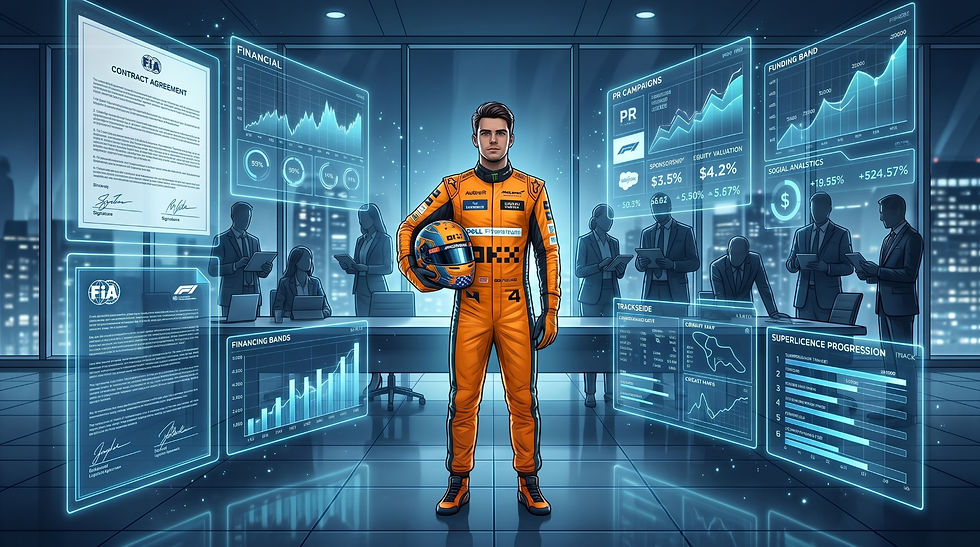
McLaren Formula 1 race winner Oscar Piastri and JAM Sports Management—directed by nine-time Grand Prix victor Mark Webber and Ann Neal—have formally dissolved their management partnership by mutual agreement following the 2026 São Paulo Grand Prix at Interlagos. Four years after mounting a landmark legal defense before the FIA Contract Recognition Board (CRB) to secure Piastri’s Formula 1 debut, the high-profile separation marks a fundamental restructuring of Piastri’s commercial representation and trackside engineering support. The split underscores the rapid evolution of modern Grand Prix talent representation, transitioning drivers from junior academy venture models to bespoke corporate holding vehicles and in-house performance teams.
The need for sophisticated representation has never been more pronounced. With constructor enterprise values escalating under financial regulations and international brand interest expanding, an elite driver represents both an indispensable sporting asset and an independent commercial enterprise. The management entity acts as a strategic executive board, insulating the athlete from non-performance liabilities so that complete operational focus can remain on vehicle dynamics and engineering debriefs (Motorsport.com, August 7, 2024).
The Modern F1 Manager: Contract Engineering, IP Rights, and Paddock Diplomacy
Modern driver management functions through an integrated 360-degree executive support ecosystem engineered to mitigate legal, financial, and political friction (Motorsport.com, August 7, 2024). In an operational environment characterized by high-stakes negotiations and compressed racing schedules, management firms deploy four core competencies.
Contractual Engineering and Exit Architecture
Contractual negotiation within Formula One extends well beyond baseline salary benchmarks. Elite agencies structure multi-layered employment agreements detailing points-scoring compensation, podium escalators, race-win bonuses, and global championship incentives. More critically, managerial attorneys design mechanical performance clauses and exit covenants that protect a driver from long-term commitment to uncompetitive technical platforms (The Race, June 2026).
Commercial Arbitrage and Intellectual Property Management
Formula One constructors maintain expansive commercial partner rosters across telecommunications, financial services, luxury apparel, and consumer goods. Consequently, conflicts between team-level exclusivity covenants and a driver’s individual brand equity exist. Modern management firms negotiate complex intellectual property carve-outs within constructor contracts. These legal stipulations permit drivers to retain image rights for personal endorsement deals, lifestyle apparel lines, and private merchandise operations without triggering commercial infringement liabilities against team title partners.
Capital Formation Across Developmental Pathways
Prior to reaching the commercial viability of a Formula One seat, aspiring competitors face immense capital requirements across the single-seater feeder ladder. Management entities operate as investment facilitators and venture brokers, organizing multi-party sponsor consortia, securing commercial equity covenants, and soliciting private wealth investments. Agencies oversee placement strategies across Formula 4, Formula 3, and Formula 2, identifying premier racing outfits to optimize the driver’s accumulation of FIA Superlicence points (Tim Sugden Motorsport; Senndit).
Trackside Diplomatic Insulation and Administrative Operations
The global expansion of the Formula One calendar places unprecedented logistical and psychological demands on drivers. Management entities coordinate cross-border travel logistics, manage international tax residencies across low-friction jurisdictions, and supervise bespoke entourages comprising physiotherapists, nutritionists, and mental performance specialists (Motorsport.com, August 7, 2024; Tim Sugden Motorsport). At the circuit, the manager serves as an emotional and diplomatic shock absorber. By interfacing directly with team ownership and executive leadership during operational disputes, team-order disagreements, or mechanical retirements, the management team preserves the direct technical rapport between the driver and their engineering crew (Motorsport.com, August 7, 2024; RacingNews365, April 22, 2024).
Six F1 Management Models: From Family Offices to Junior Academies
Representation across the Formula One paddock has diversified into distinct structural archetypes. The selection of an operating model reflects an athlete's career maturity, familial wealth, commercial power, and political positioning across the motorsport ecosystem (Motorsport.com, August 7, 2024).
Typology Matrix: Contemporary Grid Representation Structures
Representation Archetype | Strategic Advantages | Vulnerabilities & Risks |
Specialist Boutique Agency | Paddock credibility, deep regulatory acumen, high team responsiveness | Internal seat competition among agency clients; bandwidth limits |
Dedicated Family Office / Confidant | 100% operational focus, zero internal conflict, absolute personal loyalty | Limited agency network breadth; emotional conflation of family and business |
Proprietary Corporate Vehicle | Full commercial independence, total retention of image rights, cross-industry scaling | Significant operating overhead; viable only for global superstars with massive earnings |
Multi-Sport Hybrid Agency | Broad institutional sponsorship access, Hollywood/entertainment platforming | Agency executives lack direct pit-lane presence; distance from technical paddock dynamics |
Direct Team Junior Academy | Guaranteed development financing, elite engineering resources, direct path to F1 cockpit | Restrictive unilateral constructor options, constrained market mobility if team seats are locked |
Self-Representation | 100% retention of earnings, complete autonomy, unmediated executive communication | Absence of professional buffer during disputes; risk of damaging team relations |
Specialist Motorsport Boutique Agencies
Specialist agencies are founded and managed by former professional drivers, engineers, or paddock executives who concentrate on a selective stable of elite competitors. Prominent examples include Nicolas Todt’s All Road Management (representing Charles Leclerc), Didier Coton’s Aces Management Group (representing Valtteri Bottas), and Fernando Alonso’s A14 Management (guiding Gabriel Bortoleto) (Motorsport.com, August 7, 2024). These firms leverage deep paddock relationships, and operational knowledge of junior categories to position drivers favorably with top constructors.
Dedicated Family Offices and Confidants
The dedicated family office framework consolidates managerial operations into a closed advisory board centered around familial trust and specialized business management. The most prominent operational deployment is seen with Max Verstappen, whose business operations are directed by Raymond Vermeulen alongside Jos Verstappen. A comparable structure supports Carlos Sainz, whose career is managed by his cousin, Carlos Oñoro Sainz, with strategic counsel from Carlos Sainz Sr. (Motorsport.com, August 7, 2024).
This model ensures complete alignment of financial interests, unmatched personal loyalty, and undivided operational attention (RacingNews365, April 22, 2024). The primary vulnerability lies in network concentration: single-client entities lack the shared intelligence, cross-promotional platforms, and diverse commercial networks maintained by institutional agencies.
Proprietary Corporate Holding Vehicles
Established, high-earning global athletes often transition from third-party representation toward independent corporate structures. Lewis Hamilton institutionalized this model in 2015 by founding Project Forty Four (now called Lewis Hamilton Ventures), an independent holding vehicle designed to control his commercial licensing, media production ventures, and philanthropic foundations (Lewis Hamilton Ventures).
In January 2024, Hamilton demonstrated the operational flexibility of this structure by reinstating long-time associate Marc Hynes to direct trackside racing logistics, while concluding an overarching advisory relationship with Penni Thow’s Copper Management to refocus his internal staff on expanding proprietary business ventures (Motorsport.com, January 30, 2024; GPFans, January 29, 2024). While this model provides total autonomy and preserves intellectual property within the driver’s balance sheet, it incurs substantial corporate overhead, making it viable only for marquee athletes with extensive non-racing earning power.
Multi-Sport Hybrid Agencies
The hybrid model pairs global entertainment and talent management conglomerates with specialized trackside racing managers. Daniel Ricciardo aligned with Creative Artists Agency (CAA) to govern global entertainment and commercial opportunities, while Blake Friend managed operational trackside affairs (Motorsport.com, August 7, 2024).
This typology maximizes cross-industry brand value, facilitating entry into global mainstream media and entertainment markets. However, it can generate operational distance between corporate agency executives located in entertainment hubs and the fast-paced, politically charged pit lane.
Direct Constructor Junior Academy Representation
Constructor academies bypass third-party agencies during an athlete’s developmental years, placing young talent under direct contractual management by Formula One teams. George Russell rose through the feeder series under Mercedes junior management alongside Harry Soden, while Andrea Kimi Antonelli was managed through karting and junior formulas under the direct guidance of Mercedes Team Principal Toto Wolff.
This structure provides full development funding, top-tier testing infrastructure, and direct access to simulator programs. Its fundamental drawback is the restriction of driver mobility: constructors safeguard their investments through unilateral, long-term contractual options that can delay market progression or prevent drivers from pursuing competitive race seats elsewhere.
Self-Representation
A minority of established veterans dispense with managerial intermediaries, interfacing directly with team principals and constructor boards. Kevin Magnussen adopted self-representation following a split from his former management, personally negotiating his commercial contracts to retain commission percentages (Motorsport.com, August 7, 2024). Lance Stroll utilizes a distinct in-house advisory configuration, assisted by executive advisors Steve O'Connor and Mel Hoppenheim within his family’s broader organizational structure (Motorsport.com, August 7, 2024). Self-representation eliminates agency deductions but removes the diplomatic buffer that insulates an athlete during contentious contractual disputes.
The Piastri Precedent: How Mark Webber Defeated Alpine at the FIA CRB
The management partnership between Oscar Piastri and JAM Sports Management—led by former Red Bull Racing driver Mark Webber and Ann Neal—provides an instructive case study of legal positioning, market leverage, and eventual structural divergence (Auto Action, March 1, 2020; Formula1.com, November 9, 2026).
The Inception and Feeder Hegemony
JAM Sports Management assumed operational control of Piastri's career in late 2019 following his Formula Renault Eurocup championship victory. Webber and Neal integrated the young Australian into the Renault Sport Academy while orchestrating title-winning placements at Prema Racing (The Race, November 9, 2026). Under JAM's guidance, Piastri achieved back-to-back rookie triumphs in the 2020 FIA Formula 3 Championship and the 2021 FIA Formula 2 Championship.
The Alpine Contract Recognition Board Adjudication
The defining milestone of the Webber-Piastri partnership occurred during the summer of 2022, highlighting the decisive role of legal engineering in safeguarding athletic career mobility (The Race, November 9, 2026). While Piastri fulfilled reserve duties for the Alpine Formula One Team in 2022, Alpine executive management repeatedly delayed delivering a binding race agreement for the 2023 season, relying instead on a non-binding term sheet signed on November 15, 2021 (RacingNews365, September 2, 2022).
Paddock reporting and legal disclosures confirmed that Alpine's Director of Legal Affairs, Benedicte Mercer, acknowledged internally that she was "the bottleneck" due to severe departmental resource constraints (RacingNews365, September 2, 2022). Leveraging Alpine’s procedural delays, Webber engaged in negotiations with McLaren CEO Zak Brown. On July 4, 2022, Webber executed a binding employment contract between Piastri and McLaren Racing to replace Daniel Ricciardo for the 2023 season (The Race, September 3, 2022; The Mirror, September 2, 2022).
When Alpine announced Piastri as their confirmed race driver on August 2, 2022—following Fernando Alonso's departure for Aston Martin—Piastri issued a public denial:
"I understand that, without my agreement, Alpine F1 have put out a press release late this afternoon that I am driving for them next year. This is wrong and I have not signed a contract with Alpine for 2023. I will not be driving for Alpine next year." (Formula One, August 2, 2022)
The dispute went before the FIA Contract Recognition Board (CRB) in Geneva, Switzerland. On September 2, 2022, a four-member tribunal comprising Ian Hunter QC, Stefano Azzali, Prof. Dr. Klaus Peter Berger, and Matthieu de Boisseson ruled unanimously that McLaren held the sole valid employment contract for Piastri's driving services (RacingNews365, September 2, 2022).
The tribunal highlighted Alpine’s administ2rative failure, assessing total legal and administrative liabilities of £530,467.14 against the Enstone team. This included McLaren's legal costs of £229,965.00, Piastri's legal fees of £120,086.14, CRB administrative costs of £16,000, and individual arbitrator compensation ranging from £34,000 to £74,400 per tribunal member (RacingNews365, September 2, 2022).
Strategic Divergence and the Severance of November 9, 2026
Four years after the CRB ruling, the operational requirements of the partnership changed. On November 9, 2026, following the São Paulo Grand Prix at Interlagos, Piastri and JAM Sports Management jointly announced the mutual termination of their management agreement (Formula1.com, November 9, 2026).
Mark Webber characterized the conclusion as a natural evolution:
"We are proud to have played a pivotal role in the formative years of Oscar's career and to have placed him in F1 so that he could compete at the front so early on. Following our reduced trackside involvement this season, we have collectively agreed that now is an appropriate time to bring our management agreement to a close. This will allow Oscar to build on his achievements under a new management structure, and for us to embark on our new ventures. We wish Oscar all the very best for a long and successful career" (Formula1.com, November 9, 2026).
Piastri offered reciprocal acknowledgment:
"I'd like to thank Mark and Ann for all their support and advice over the years. Their guidance has been invaluable, particularly in navigating the beginning of my F1 career. I wish them all the best going forward" (Formula1.com, November 9, 2026).
The formal split concluded an operational transition initiated in early 2026. At pre-season testing in Bahrain, Webber and Neal stepped back from daily paddock attendance (Motorsport.com, November 9, 2026). Addressing this operational shift at the time, Piastri noted:
"There wasn't anything specific, just we made a decision for things to look a bit different. Mark is still very much involved and I've been in contact with him a lot over the last few weeks. He just won't be trackside as much anymore" (Motorsport.com, November 9, 2026).
Behind the cooperative public statements, paddock reporting pointed to operational friction originating during the 2025 World Championship. Webber reportedly grew dissatisfied with McLaren's management of the intra-team title fight between Piastri and Lando Norris, specifically concerning team-order protocols and adverse strategic decisions. Furthermore, Webber contested McLaren's technical explanations regarding Piastri’s performance drop-off during the final quarter of the 2025 season (The Race, November 9, 2026).
With Piastri established as a Grand Prix winner and signed to a secure long-term McLaren contract, the need for an external heavyweight advocate decreased relative to maintaining operational harmony with team management. Concurrently, Piastri expanded the trackside responsibilities of internal personnel, including his former Prema race engineer Pedro Matos and mental performance coach Emma Murray, moving toward a driver-centric performance model (Formula1.com, November 9, 2026).
Why Formula 1’s Next Great Financial Battle May Happen Off the Track
Oscar Piastri’s journey from a £530,467 courtroom victory to an amicable split with JAM Sports illustrates the fundamental financial law of modern Formula 1: the representation that gets a driver onto the grid may not be the structure that maximizes their earnings once they start winning. Breaking into Grand Prix racing demands aggressive legal advocacy, venture backing, and shrewd political maneuvering. Yet once a driver secures long-term contractual leverage and race-winning credentials, power shifts inward—toward proprietary holding companies, tax-optimized commercial portfolios, and tight operational alignment with team leadership. As Formula 1 constructor valuations continue to climb, the sport’s fiercest off-track competition will no longer be fought merely for a cockpit, but for total financial ownership of the athlete inside it.
Additional Articles on Human Capital


Comments