


Why Formula 1 Is Trading European Heritage for a $60M African Grand Prix
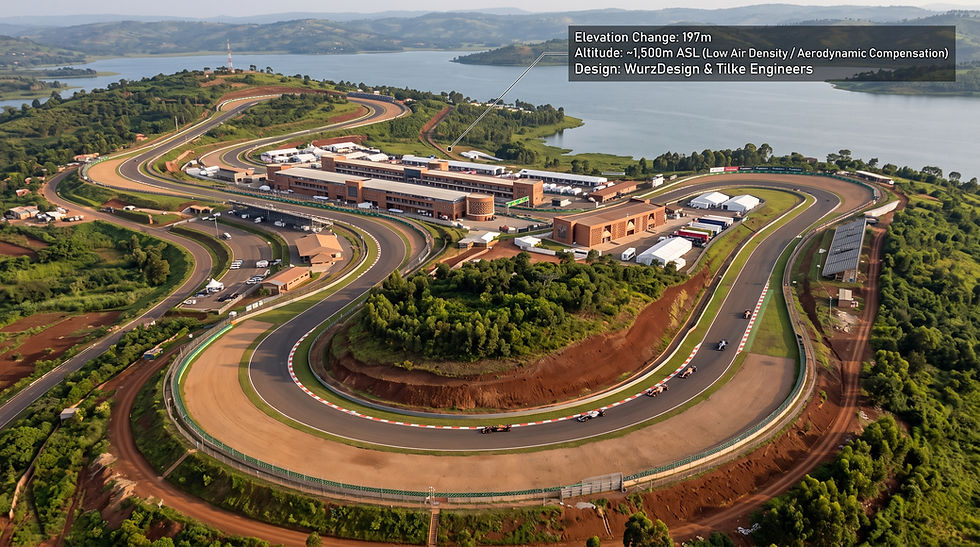
Every Formula 1 constructor’s balance sheet hinges on a ruthless piece of arithmetic: the championship calendar is legally capped at 24 races, and European heritage circuits paying $25 million simply cannot compete with emerging-market money. When commercial rights holder Liberty Media signed a 10-year deal to bring the World Championship to Rwanda’s Bugesera district, it pulled off more than a milestone continental return—it executed a calculated financial coup. By swapping modest European sanction fees for an overseas contract commanding up to $60 million annually, Formula 1 is directly inflating the central Adjusted EBIT pool that funds team prize payouts. Yet behind the promise of 100 million new fans and an integrated $1.3 billion logistics corridor lies a high-wire financial gamble involving private equity syndicates, sovereign debt ceilings, and geopolitical crosswinds that every paddock CFO is quietly calculating.
The transaction introduces a commercial structure that departs from conventional state-underwritten emerging market hosting models. By deploying a blended financing vehicle that pairs sovereign inter-agency coordination with private equity syndication, the Rwandan government seeks to insulate its national budget while anchoring the project to the broader $1.3 billion Bugesera International Airport logistics corridor (Mail & Guardian, October 16, 2026). However, the initiative operates under significant structural cross-pressures. The promoters and the championship must reconcile elevated sovereign debt burdens, persistent regional geopolitical volatility in the Great Lakes region, and corporate exposure to international governance scrutiny (Associated Press, October 13, 2026).
Simultaneously, integrating Bugesera into an already saturated calendar governed by a strict 24-race regulatory ceiling under the Concorde Agreement requires Formula One Management (FOM) to dismantle traditional hosting models, accelerating the biennial rotation and potential displacement of legacy European venues.
Capital Financing Architecture and Public-Private Syndication
The financing framework established for the Bugesera motor racing complex represents an evolution in sports infrastructure capitalization. Historically, emerging market host nations—ranging from Sochi and Baku to Istanbul and Yeongam—relied almost exclusively on direct sovereign guarantees and direct treasury underwriting to fund track construction and meet escalating annual sanction fees. In contrast, the Rwandan framework relies on a multi-stakeholder syndicate designed to mitigate sovereign balance-sheet liability (Mail & Guardian, October 16, 2026).
Institutional stewardship of the project is directed by the Rwanda Development Board (RDB). Rather than absorbing the capital expenditure directly through public debt issuance, the RDB assembled an international consortium of private equity funds, institutional investment vehicles, family offices, and high-net-worth individuals (Mail & Guardian, October 16, 2026). Jean-Guy Afrika, Chief Executive of the Rwanda Development Board, outlined this financing philosophy:
"We've assembled a global consortium of public and private actors. Suffice to say that we have witnessed tremendous interest from the private sector — family offices, investment funds, high-net-worth individuals. Ultimately, it's likely to be an initiative that is powered by the private sector and coordinated by the government" (Mail & Guardian, October 16, 2026).
Under this division of responsibilities, the Rwandan government deploys its sovereign authority to de-risk planning approvals, execute land assembly across the Bugesera parcel, and provide inter-agency civil coordination. The private investment consortium, meanwhile, assumes operational construction risk and equity exposure.
Project Stakeholder Tier | Entity / Institutional Lead | Core Responsibilities and Mandate | Capital Allocation & Risk Profile |
Sovereign Authority | Government of the Republic of Rwanda | Statutory planning, land assembly, environmental permitting, inter-agency civil coordination, and regional arterial transport links | Non-CapEx sovereign de-risking; zero direct balance-sheet construction debt underwriting (Mail & Guardian, 2026) |
Project Coordinator | Rwanda Development Board (RDB) | Public-private syndication structuring, pan-African tourism promotion ("Visit Rwanda"), and commercial rights oversight | State agency liaison managing multi-stakeholder governance and international promoter agreements (World Business Journal, 2026) |
Private Equity Syndicate | International Investment Consortium (PE funds, family offices, HNWIs) | Circuit earthworks, asphalt paving, paddock structures, FIA homologation compliance, and commercial asset capitalization | Private equity and debt syndication assuming operational construction and commercial execution risk (Mail & Guardian, 2026) |
Strategic Aviation Anchor | Qatar Airways / Government JV | Construction and commissioning of the $1.3B Bugesera International Airport logistics gateway | 60% controlling equity stake held by Qatar Airways; commissioning targeted for early 2028 (Pax News, 2026) |
Motorsport Asset Delivery | WurzDesign / Tilke Engineers JV | Engineering design, topographic integration, circuit safety systems, and multi-use operational infrastructure | Blended asset development spanning a 6.000 km track, convention hub, and Ministry of Sports karting academy (Formula 1, 2026) |
The capital efficiency of the motorsport venue is further optimized through its geographic co-location with the new Bugesera International Airport, scheduled for commissioning in early 2028. The international aviation hub represents a $1.3 billion infrastructure initiative in which Qatar Airways holds a 60% controlling equity interest (Mail & Guardian, October 16, 2026). Positioning the motor racing facility within the immediate perimeter of this transport node enables significant operational synergies.
The motorsport development absorbs shared civil infrastructure—including high-capacity electrical sub-stations, municipal water connections, high-volume air cargo handling terminals, and dedicated arterial transit corridors connecting Bugesera to Kigali, situated approximately 40 kilometres to the north (The Guardian, October 13, 2026; Mail & Guardian, October 16, 2026). By amortizing heavy utility and transportation capital costs across the broader airport development corridor, the standalone capital expenditure required for the motor circuit itself is substantially reduced.
Macroeconomic Vulnerability and Geopolitical Risk Analysis
Despite innovative capital structuring, the African Grand Prix agreement operates within a macroeconomic environment marked by sovereign fiscal constraints. In its sovereign credit assessment, Fitch Ratings affirmed Rwanda’s Long-Term Foreign-Currency Issuer Default Rating at 'B+' with a Stable outlook (Minecofin).
Beyond fiscal dynamics, the commercial agreement intersects complex geopolitical and reputational currents. The Great Lakes region continues to experience deep cross-border diplomatic tensions surrounding the ongoing conflict in the eastern Democratic Republic of the Congo. United Nations panels of experts and the United States government have alleged that Rwandan state forces have provided operational support to the M23 rebel movement—allegations that the Rwandan government disputes, characterizing its regional security posture as essential defensive measures against hostile regional militias (Associated Press, October 13, 2026). In March 2024, the United States enacted targeted bilateral sanctions against senior Rwandan military officers connected to the regional conflict.
Simultaneously, international non-governmental organizations, including Amnesty International, have intensified criticism of major sports properties partnering with the Rwandan government, arguing that high-profile sports sponsorships serve to deflect international scrutiny from domestic political governance and civic restrictions (Amnesty International, October 13, 2026). Consequently, multinational brands considering commercial alignment with the African Grand Prix must navigate an intricate matrix of corporate social responsibility (ESG) standards and secondary regulatory compliance.
Commercial Terms, Circuit Architecture, and Asset Versatility
The master agreement signed by Formula One Management and Rwandan authorities grants a 10-year term to stage the event, targeting an official calendar debut in the "early 2030s" once civil construction and FIA circuit homologation are complete (Formula 1 Press Office, October 13, 2026). Stefano Domenicali, President and Chief Executive Officer of Formula 1, emphasized the historical and commercial importance of the agreement during its formal ratification:
"Today is a landmark moment for Formula 1. With Rwanda joining the calendar from the next decade, our sport will race in every inhabited continent, bringing the World Championship closer than ever to fans around the globe. Africa has always been part of Formula 1’s future, and from the beginning we were determined to return in the right way, with the right partner, a long-term commitment and a clear vision for creating meaningful impact" (Formula 1 Press Office, October 13, 2026).
Rwandan President Paul Kagame echoed this strategic perspective, framing the grand prix as an economic engine for the region:
"Today belongs to Africa. For more than three decades, the world's premier motorsport championship has raced without this continent, and that changes with this agreement. Rwanda is proud to host the Formula 1 African Grand Prix, and to share this moment with more than 100 million fans across Africa... The circuit in Bugesera, alongside the new international airport, will bring jobs, skills, tourism and new business to our country and our region for decades to come, because our aim was never a single race weekend, but a lasting benefit for our people" (Formula 1 Press Office, October 13, 2026).
From a regulatory perspective, FIA President Mohammed Ben Sulayem affirmed the governing body's technical oversight:
"The return of the FIA Formula 1 World Championship to Africa is a historic moment for our sport and an important step in the continued global growth of motorsport. Rwanda has demonstrated a strong commitment to delivering a world-class event, and the FIA will work closely with FOM and our partners as this new circuit is developed to the highest international standards" (Formula 1 Press Office, October 13, 2026).
Parameter | Bugesera Circuit (Rwanda) | Circuit de Spa-Francorchamps (Belgium) | Circuit de Barcelona-Catalunya (Spain) |
Contract Duration | 10 Years | Rotational Contract | Rotational Contract |
Active Term | Early 2030s+ | 2026, 2027, 2029, 2031 | 2028, 2030, 2032 |
Circuit Length | 6.000 km | 7.004 km | 4.657 km |
Corner Count | 17 Turns | 19 Turns | 14 Turns |
Elevation Change | 197.0 metres | 102.2 metres | ~30.0 metres |
Altitude Above Sea Level | ~1,500 metres | ~400–470 metres | ~120 metres |
Daily Spectator Capacity | 100,000 | 110,000 | 110,000 |
Projected Weekend Capacity | ~300,000 | 380,000 | ~300,000 |
Industry Sanction Fee | Undisclosed ($20-60M range) | ~$25M | ~$25M |
To deliver a facility capable of obtaining an FIA Grade 1 license, the promoter engaged a joint venture between WurzDesign, led by former Grand Prix driver Alexander Wurz, and Tilke Engineers & Architects, led by Carsten Tilke (Formula 1 Press Office, October 13, 2026). The design leverages the topography of two natural hillsides bordering a lake, creating a 6.000-kilometre, 17-turn anti-clockwise circuit featuring 197 metres of elevation change per lap (Formula 1 Press Office, October 13, 2026).
The circuit's geography presents unique engineering demands. Situated approximately 1,500 metres above sea level, Bugesera operates in thin atmospheric air, reducing ambient aerodynamic downforce on Formula 1 machinery. Alexander Wurz detailed the design response to these physical parameters:
"When we learned about the development in Bugesera, and then we actually saw it, and you see the hillsides and the lakes, I said, 'guys, there's only one location this circuit should be, because it doesn't need us to design it, because the nature designed already the perfect topography. It's two hills with the lake below, that means we can drive up and down the beautiful landscape'... That means we have less pressure in the air, that means also less grip from the aerodynamics. So we can counter that with some of the cambers" (Formula 1 Press Office, October 13, 2026).
Carsten Tilke highlighted the sporting and operational focus of the circuit architecture:
"It was always important for us that it's amazing to drive, challenging to drive, but on the other hand, also creating great races. So we needed to create overtaking points, we needed to make sure different strategies are possible on that track... The other thing very important for us was [that] the focus was always the spectator. Spectators must be close to the track, must feel the track, must be part of it. It really is a roller coaster track" (Formula 1 Press Office, October 13, 2026).
To prevent the complex from becoming an underutilized capital asset outside the annual grand prix window, the master development plan establishes an integrated, year-round operating model (Pax News, October 13, 2026). The site includes permanent paddock hospitality spaces incorporating traditional Rwandan architectural forms, an automotive performance center, off-road testing facilities, a commercial convention center, and a permanent motorsport academy run in partnership with the Ministry of Sports (Mail & Guardian, October 16, 2026). Nelly Mukazayire, Rwanda’s Minister of Sports, underscored the domestic human-capital strategy underpinning the development:
"We are not looking at an event where we're just spending and they are coming and they are going, we are looking at an investment. And that investment looks also at the motorsport itself in terms of competitions... a component of that race and that entire project has also an academy for motorsport. Which is to also grow the talent of Africans in terms of motorsports, not only F1 but also others" (Mail & Guardian, October 16, 2026).
Demographic Capture, Commercial ROI, and Sub-Saharan Growth
Liberty Media’s expansion into Bugesera aligns with macro-level demographic shifts across the global sports media industry. Official Formula 1 research identifies an established audience base exceeding 100 million individuals across the African continent, with nearly 60% of followers in primary sub-Saharan markets under 35 years of age (Formula 1 Press Office, October 13, 2026).
This youthful demographic profile mirrors Rwanda’s domestic census data from 2022, which recorded a population of 14.6 million, including 3.4 million individuals aged 16 to 30 (comprising 1.8 million females and 1.6 million males) (Formula 1 Press Office, October 13, 2026). For multinational championship partners across fintech, consumer technology, telecommunications, and energy, sub-Saharan Africa offers long-term consumer growth potential that contrasts sharply with the maturing, demographic-plateau markets of Western Europe.
Metric Domain | Specific Indicator / Demographic Cohort | Quantified Dimension | Strategic Commercial Relevance |
Pan-African Audience | Total Continental F1 Follower Base | >100,000,000 individuals | Demonstrates critical mass of latent sports consumer interest across sub-Saharan Africa |
Age Distribution | Sub-Saharan F1 Followers Under 35 | ~60% of regional followers | High-value consumer segment for global digital, fintech, and telecommunications partners |
Host Demographics | Rwanda Domestic Population | 14.6 million (2022 Census) | Rapidly urbanizing domestic market anchoring the East African Community footprint |
Host Youth Cohort | Rwanda Residents Aged 16–30 Years | 3.4 million (1.8M F / 1.6M M) | Strong domestic talent pool feeding technical academies, logistics, and hospitality services |
Venue Capacity | Daily Bugesera Ticketed Capacity | 100,000 spectators / day | Aligns venue throughput with tier-one international hosting standards |
Economic Footfall | Projected 3-Day Grand Prix Attendance | ~300,000 total weekend visits | Generates substantial indirect tax yield across aviation, hotel lodging, retail, and catering |
The Rwanda Development Board projects that the venue will support a daily attendance capacity of 100,000 spectators, translating to a three-day weekend footfall of approximately 300,000 attendees (Mail & Guardian, October 16, 2026). RDB CEO Jean-Guy Afrika noted that this volume of international and domestic visitors is designed to stimulate demand across hotel capacity, regional aviation, road transport, catering, and domestic retail, generating substantial indirect tax returns through VAT and corporate income levies.
By marketing the round under the pan-continental title "Formula 1 African Grand Prix, presented by Visit Rwanda," the state aims to attract premium sports tourism from across East, West, and Southern Africa rather than relying solely on local domestic ticket sales (Mail & Guardian, October 16, 2026).
At the constructor level, market reception has been measured. Several frontline constructor teams, including the Mercedes-AMG PETRONAS F1 Team and McLaren Racing, issued formal corporate statements noting Formula 1’s return to Africa (Mercedes-AMG PETRONAS F1 Team Press Room, October 12, 2026; McLaren Racing, October 13, 2026).
Calendar Reallocation Mechanics and Prize Fund Economics
Formula 1’s entry into Rwanda accelerates a fundamental reorganization of the World Championship calendar. Under the governing Concorde Agreement, the championship operates under a binding ceiling of 24 events per season. FIA President Mohammed Ben Sulayem has stated that exceeding 24 Grands Prix would cross an unacceptable operational and human-resource threshold:
"You cross a barrier [24] where you need two teams. We can't have any [more]," the FIA president told Autosport. “As for the FIA, we cannot do it with this one team. We have to have a rotation of two teams when it comes to the staff on the ground.” (GPblog, October 13, 2024).
Formula 1 Chief Executive Stefano Domenicali has reinforced this position, stating that 24 rounds represents the optimum commercial ceiling, mandating that geographic diversification must occur through structural race rotation rather than continuous calendar expansion (Grand Prix 247, November 8, 2024).
To accommodate new international fixtures without breaching regulatory caps, Formula 1 has systematically deployed alternating biennial promoter agreements across historic European circuits. The Circuit de Spa-Francorchamps agreed to a multi-year extension through 2031 that restricts the Belgian Grand Prix to four appearances across six seasons: 2026, 2027, 2029, and 2031, leaving it off the calendar in 2028 and 2030 (Formula 1 Press Office, January 8, 2025).
Concurrently, the Circuit de Barcelona-Catalunya executed an extension through 2032 to host races exclusively in 2028, 2030, and 2032, alternating directly with Spa as the new MADRING hybrid circuit in Madrid assumes the permanent Spanish Grand Prix title starting in 2026. With contracts for other traditional European venues, such as the Autodromo Enzo e Dino Ferrari in Imola and Circuit Zandvoort, nearing maturity, FOM is curating vacancies to accommodate international venues like Rwanda and returning tracks like Portimão (AutoWeek, February 16, 2026).
This geographic substitution has a direct mathematical impact on Formula 1's prize fund mechanics. As disclosed in Liberty Media Corporation’s SEC filings, constructor prize distributions represent a contractually defined percentage of Formula 1's "Prize Fund Adjusted EBIT," calculated by deducting central operating expenses from total primary revenue (Liberty Media Corporation 10-K, 2024; Liberty Media Corporation 10-K, 2025).
While legacy European circuits typically pay annual hosting fees of approximately $20 million to $25 million—frequently backed by local municipal subsidies—new non-European host contracts command sanction fees ranging from $30 million to $60 million annually (RacingNews365, October 13, 2026). By substituting lower-yielding European races with higher-fee overseas destinations, Formula 1 expands its operating income and Adjusted EBIT margins, directly bolstering the aggregate prize fund distributed among the 10 competing constructors under the Concorde Agreement.
Why Formula 1’s $60M African Bet Must Pay Off for Paddock Balance Sheets
At its core, Formula 1’s expansion into Rwanda is a financial calculation governed by a rigid 24-race ceiling: Liberty Media is betting that overseas sanction fees topping $60 million can subsidize constructor prize distributions where European heritage circuits paying $25 million no longer can. But that margin depends entirely on flawless execution. With Rwanda’s national debt forecast at 83.5% of GDP (Market Forces Africa, September 27, 2025), the private equity syndicate must absorb every cent of construction overrun, while commercial sponsors navigate regional sanctions and human rights scrutiny. If the Bugesera facility succeeds as a year-round revenue engine, it delivers a lucrative blueprint for emerging-market expansion and pumps vital cash into constructor coffers. If it falters, paddock CFOs and fans alike will face the stark reality that irreplaceable motorsport heritage was traded away for an unhedged financial gamble.
Additional articles on Liberty Media's Finances & Economics


Comments